


Tripura launches TRESP rural livelihood initiative with Rs 1,400 crore funding to strengthen tribal economy, livestock farming, fisheries, veterinary services, and women-led producer groups. Sudhangshu Das says the project will transform rural communities through modern training, financial support, and doorstep veterinary care.
A major rural development initiative aimed at transforming tribal livelihoods and strengthening the livestock economy was launched in Tripura on Thursday during a state-level workshop and kit distribution programme held at Pragna Bhavan in Agartala. The programme, organized under the Tripura Rural Economic Growth and Service Delivery Project (TRESP), also witnessed the unveiling of the department’s official logo and the introduction of several new veterinary service initiatives.
Addressing the gathering, Sudhangshu Das, Minister for Animal Resource Development, Fisheries, and SC Welfare, described TRESP as a “game changer” for the state’s tribal and rural economy. He said the initiative would significantly improve the income and living standards of rural households through livestock development, fisheries expansion, skill enhancement, and modern veterinary support systems.
The Minister stated that although Tripura remains primarily dependent on agriculture, the animal husbandry and fisheries sectors possess enormous untapped potential capable of reshaping the rural economy. He stressed the importance of close coordination between the Animal Resource Development Department, Tribal Welfare Department, and Tripura Rural Livelihood Mission to ensure the success of the ambitious project.
According to Das, TRESP is the largest multi-sectoral rural development project undertaken in Tripura so far, with a total investment of Rs 1,400 crore. Of this amount, Rs 1,200 crore has been financed by the World Bank, while the remaining share is being provided by the state government. The project will be implemented over six financial years, from 2023-24 to 2028-29.
The initiative focuses on promoting piggery, poultry, goat rearing, dairy farming, and fisheries activities across rural and tribal areas. It also includes large-scale training programmes, vaccination support, technical guidance, feed distribution, and financial assistance for small-scale entrepreneurs engaged in livestock and fisheries businesses.
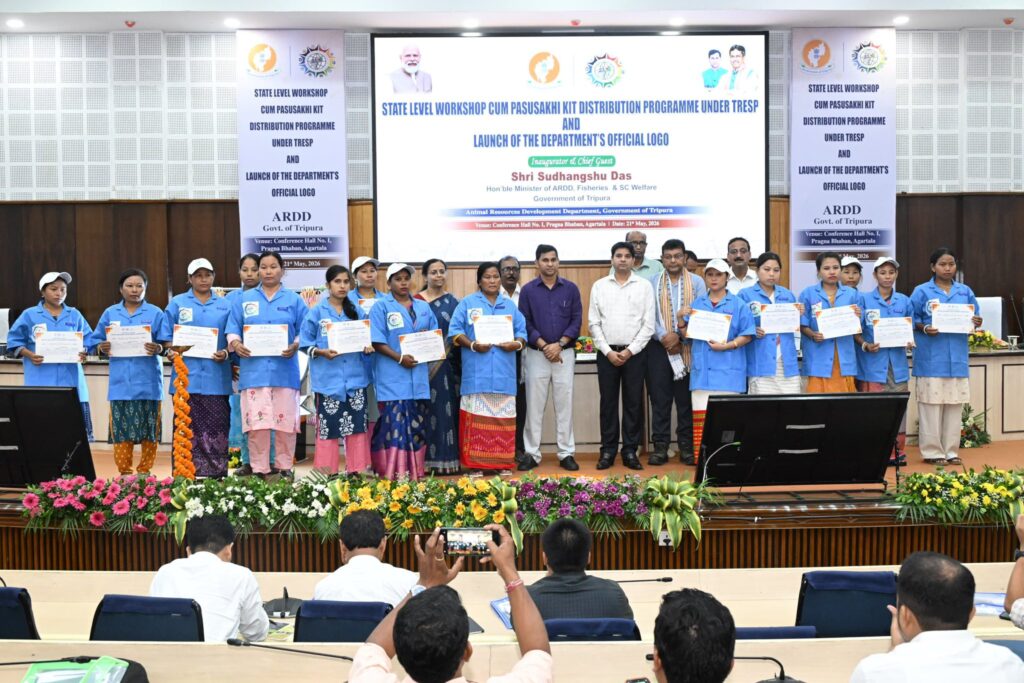
Highlighting women’s participation in the programme, Das informed that 950 Producer Groups (PGs) have already been formed under TRESP, benefiting more than 22,000 rural women across the state. These groups are being trained and supported by specially trained “Pashu Sakhis” and “Matsya Sakhis” to establish sustainable livestock and fisheries enterprises at the grassroots level.
During the programme, kits and certificates were distributed to 80 Pashu Sakhis. The distributed kits included specialized artificial insemination equipment for pig farming, aimed at improving breeding quality and increasing productivity in rural households. Officials said the initiative would help introduce modern scientific methods into traditional farming practices.
The Minister also announced the launch of the “Bharat Sanjivani” project, a major veterinary service initiative designed to improve animal healthcare accessibility in remote villages. Under the programme, farmers will be able to access veterinary assistance through a toll-free helpline numbered 1962 and a dedicated mobile application.
As part of this initiative, Mobile Veterinary Units (MVUs) have been deployed across Tripura to provide doorstep veterinary care. At present, 13 MVUs are operational in different districts, and the government plans to increase their numbers in the coming years. These mobile units are expected to reduce livestock diseases, improve animal productivity, and strengthen rural income generation.
Das further claimed that Tripura has already achieved self-sufficiency in meat production and is now working towards attaining similar independence in milk, fish, and egg production. He urged all government departments and associated agencies to work collectively to ensure that rural and tribal communities become economically self-reliant and resilient.
The event was attended by senior officials and experts, including Deepa D. Nair, Secretary of the Animal Resource Development Department, Subhashish Das, Director of Tribal Welfare, and Kishore Sambasivam from Bharat Financial Inclusion Ltd. Technical sessions were also conducted by Utpal Karmakar, Managing Director of West Bengal Livestock Corporation, and Dr. Jyotirmoy Roy, Deputy Director of the Animal Resource Development Department.
| Also Read: Tripura Achieves Historic Drop in Infant Mortality Rate in 2024 |
Concluding his address, Minister Das reaffirmed the commitment of the BJP-led government towards tribal welfare and rural development. He stated that the administration is determined to ensure that development reaches every remote village and underserved community in Tripura through sustained investment, modern technology, and inclusive economic policies.





