Tipra Motha Party meets Governor after TTAADC term ends, as outgoing CEM resigns. Pradyot Debbarman signals tougher stance on indigenous rights, alliance tensions with BJP, and possible legal battle while new council formation process begins.
The process of forming a new council in Tripura’s autonomous district administration moved into its next phase on Saturday, as political developments unfolded following the conclusion of the council’s tenure and the recent electoral verdict.
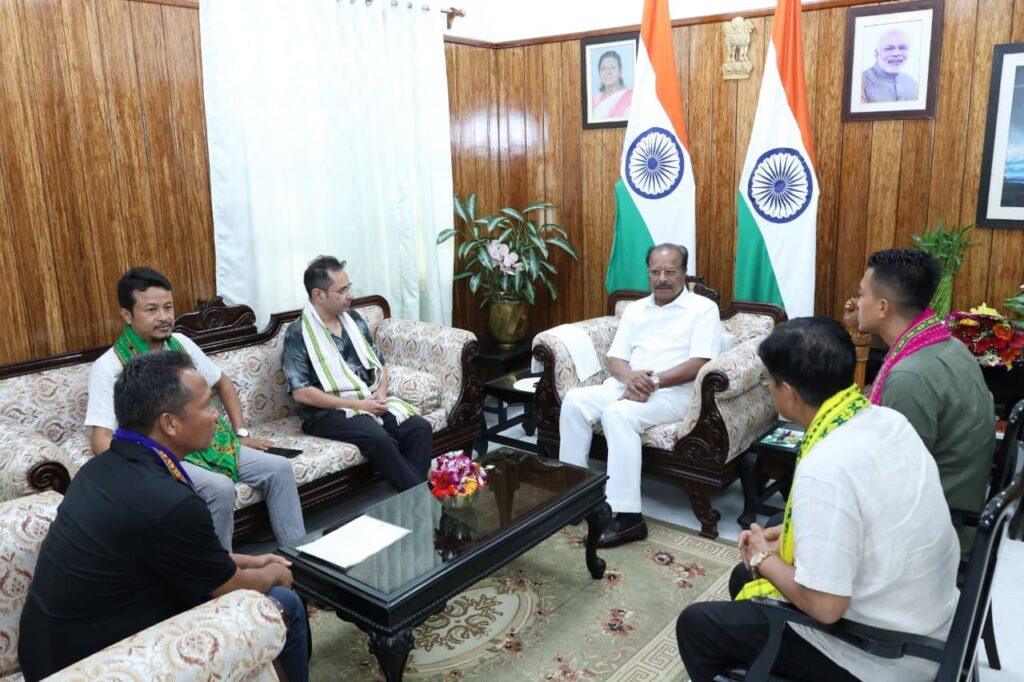
Founder of the Tipra Motha Party, Pradyot Kishore Debbarman, led a delegation to meet Indra Sena Reddy Nallu at the Raj Bhavan shortly after the term of the Tripura Tribal Areas Autonomous District Council (TTAADC) formally ended.
Outgoing Chief Executive Member Purna Chandra Jamatia submitted his resignation to the Governor, marking the official closure of the outgoing council’s tenure. The delegation included senior leaders and newly elected members, reflecting the party’s transition from electoral success to governance responsibilities.
According to Debbarman, the Governor will now initiate the constitutional procedures required to constitute the new council. Once the formal notification is issued, the party is expected to internally select its Chairman and Chief Executive Member in accordance with legal provisions governing the autonomous body.
The electoral outcome has strengthened the party’s position in the tribal council, and Debbarman indicated that internal consultations would soon take place to review the results in detail. These discussions are also expected to address the future of the party’s alliance with the Bharatiya Janata Party, amid visible signs of tension between the two partners.
Speaking to the media, Debbarman adopted a firm tone, stating that the mandate had emboldened him to be more vocal on issues concerning indigenous communities. He emphasized that there would be no compromise on the rights and interests of the people represented by the council. He further indicated that unresolved legislative and constitutional matters related to indigenous rights could potentially be taken to the Supreme Court of India, suggesting a possible legal dimension to future political strategies.
At the same time, the TMP leader raised concerns about alleged attempts by certain sections within the BJP to destabilize his party. He accused some individuals of engaging in practices such as political pressure tactics and inducements, questioning the logic of such actions within an alliance framework. He asserted that such moves would not be tolerated if both parties intended to maintain a cooperative relationship.
Debbarman also commented on internal dynamics within the BJP, alleging that a section of leaders who had previously been associated with the Communist Party of India (Marxist) had played a role in creating misunderstandings ahead of the TTAADC elections. He suggested that these developments may have contributed to friction between alliance partners and urged the state leadership to remain vigilant.
Referring to remarks reportedly made by Manik Saha regarding potential legal action against TMP leaders, Debbarman described them as personal opinions rather than an official stance of the BJP. He reiterated that political authority cannot be sustained through coercion, emphasizing the importance of democratic processes.
On questions regarding the absence of senior leader Animesh Debbarma during the election campaign, Debbarman refrained from making public comments. He noted that the matter would be discussed privately, acknowledging Animesh Debbarma’s long association with the party and his contributions in various roles, including Deputy CEM and Leader of Opposition.
The TMP chief also addressed concerns over incidents of post-election violence, describing them as unfortunate and avoidable. He confirmed that senior police officials, including the Director General of Police and district-level authorities, had been in regular communication with him. He appreciated the efforts made by law enforcement agencies to maintain order during a sensitive period.
| Also Read: TIPRA Motha Surge Jolts BJP in Tripura ADC Elections |
In a broader message, Debbarman called for unity among the region’s diverse communities. He stressed that internal conflicts could weaken collective progress and urged political workers and supporters to exercise restraint despite ideological differences. According to him, maintaining peace and cooperation is essential for ensuring stability and development in the state.
As Tripura moves toward the formation of a new autonomous council, the coming days are expected to be crucial in shaping both governance and political alignments. The decisions taken by the Tipra Motha Party regarding leadership selection and alliance strategy will likely have a significant impact on the region’s political landscape.