


Tripura Agriculture Minister Ratan Lal Nath unveiled an ambitious horticulture roadmap featuring exotic mango cultivation, advanced potato seed technologies, off-season vegetable farming, and conservation of indigenous crops. The initiative aims to achieve self-sufficiency in mango and potato production while enhancing farmer income, sustainability, and agricultural prosperity across Tripura.
In a step towards strengthening Tripura’s agricultural sector and enhancing farmers’ income, Agriculture and Farmers’ Welfare Minister Ratan Lal Nath on Saturday announced an ambitious plan to make the state self-sufficient in mango production through the introduction of several high-value exotic mango varieties at the State Horticulture Research Station (SHRS), Nagicherra.
The announcement was made during the inauguration of the Fruit & Vegetable Development Unit office building at the research station, where the Minister highlighted a series of innovative horticultural initiatives aimed at transforming Tripura into a hub of sustainable and profitable agriculture.
According to Nath, an exclusive exotic mango block has been established at the SHRS featuring premium varieties including Yellow Banana, Doc-Mai, Red Palmer, Bari-4, Brunei King, Haribhanga, Katimon, and Thai-1 Red. These varieties will undergo extensive evaluation to assess their adaptability, productivity, disease resistance, and overall performance under Tripura’s unique agro-climatic conditions.
The Minister stated that the initiative represents a major milestone in the state’s efforts to reduce dependence on mango imports and create opportunities for local farmers through the cultivation of premium-quality fruits. Successful varieties will later be propagated through quality seedling production and distributed for wider cultivation across the state.
“Tripura has immense potential in horticulture, and our objective is to identify and promote crop varieties that offer higher productivity, better market value, and greater resilience to changing climatic conditions,” Nath said.
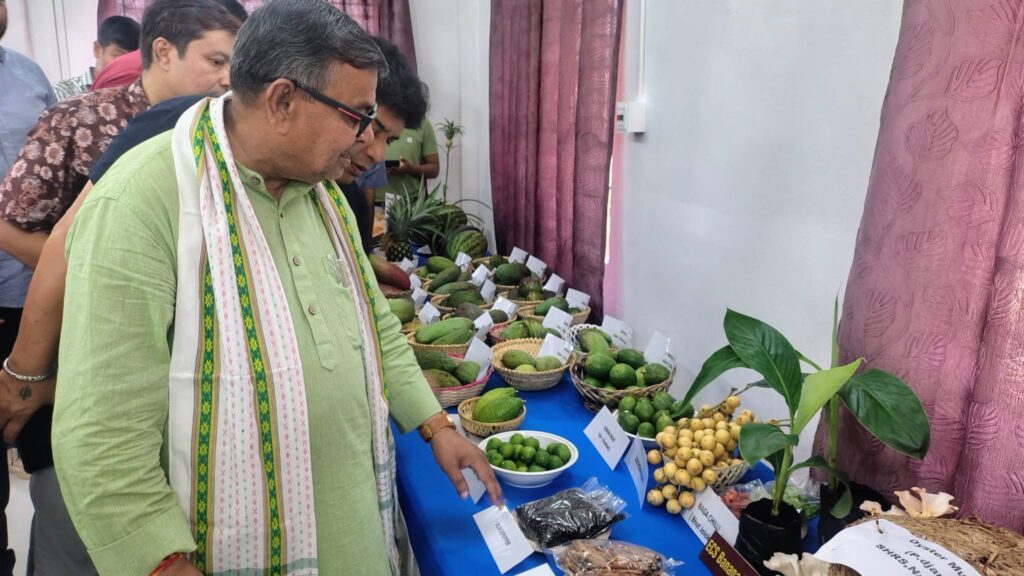
Highlighting the importance of the State Horticulture Research Station, he described SHRS as Tripura’s premier horticultural research institution, engaged in both strategic and applied research covering fruits, vegetables, spices, potatoes, mushrooms, and other important crops.
The Minister recalled that the centre initially began with valuable germplasm collections of coconut, betel nut, red oil palm, cashew, pepper, and banana. Over the years, it has evolved into a leading centre for horticultural innovation, contributing significantly to the state’s agricultural development.
Nath further emphasized the role of the Fruit Development Unit, which manages a 15-hectare research block containing a diverse collection of indigenous and exotic fruit crops. The unit focuses on introducing, evaluating, and popularizing high-yielding, climate-tolerant, and market-oriented crop varieties suitable for cultivation in Tripura.
“Our efforts are directed towards conserving valuable germplasm resources, selecting superior crop varieties, and developing innovative technologies that can increase productivity while improving farmers’ profitability,” he said.
In addition to exotic mangoes, the state is also conducting trials on winter strawberry cultivation. The project seeks to evaluate the commercial viability of strawberry farming in Tripura and explore its potential as a high-value crop for local farmers.
The Minister also highlighted the achievements of the Vegetable Innovation Unit, which is actively promoting off-season vegetable cultivation. Among its notable initiatives is the successful cultivation of summer cauliflower, enabling farmers to supply vegetables during periods of limited market availability.
Such off-season production, Nath explained, helps farmers secure better prices and higher returns while ensuring a consistent supply of fresh produce to consumers.
The Vegetable Innovation Unit is also playing a crucial role in preserving Tripura’s rich agricultural biodiversity. Indigenous germplasm resources, including Surji chilli, Bird’s Eye chilli, and Shingaratha brinjal, are being conserved to protect valuable genetic material for future crop improvement programmes.
Recognizing changing consumer preferences and emerging market opportunities, the state is also promoting the cultivation of yellow-skinned watermelon. The crop is being positioned as a premium alternative to conventional red watermelon, offering farmers access to new and potentially lucrative markets.
A major focus of the government’s agricultural strategy is potato research and seed production. Nath highlighted the success of the PM-RKVY 2022-23 project, which introduced Apical Rooted Cutting (ARC) technology for potato cultivation.
The technology has delivered remarkable results, significantly improving productivity levels. According to the Minister, average potato production has increased to 5,888 kilograms per hectare, representing nearly a 90 percent improvement compared to previous levels.
Over the past three years, the state has introduced five improved potato varieties—Himalini, Kufri Uday, Kufri Lima, Kufri Thar-12, and Kufri Moin. These varieties have shown promising performance under local conditions and are expected to contribute substantially to future production growth.
Looking ahead, Tripura has set ambitious goals for achieving agricultural self-reliance. The state aims to become fully self-sufficient in high-quality potato seed production by 2028-29 and attain complete self-sufficiency in ware potato production by 2029-30.
The Minister expressed confidence that the combined impact of exotic mango cultivation, advanced potato technologies, off-season vegetable farming, fruit diversification, and germplasm conservation would usher in a new era of agricultural prosperity for the state.
“With innovative research, scientific farming practices, and strong support for farmers, Tripura is steadily moving towards horticultural self-reliance, sustainability, and long-term prosperity,” Nath said.
| Also Read: AMC Mayor Accelerates Revival of Neglected City Ponds |
The initiatives announced at Nagicherra underscore the state’s commitment to modernizing agriculture, improving food security, and creating sustainable income opportunities for thousands of farming families across Tripura. As research and field trials continue to expand, Tripura is positioning itself as a leading example of horticulture-driven agricultural transformation in Northeast India.





