


Tripura Finance Minister Pranajit Singha Roy chairs crucial pre-budget meetings ahead of the 2026–27 Budget Session starting March 13, reviewing revised estimates, sectoral allocations, and fiscal priorities to shape a development-focused and people-centric state budget.
With the Budget Session of the Tripura Legislative Assembly for the financial year 2026–27 scheduled to commence on March 13, Finance Minister Pranajit Singha Roy on Monday chaired a series of high-level preparatory meetings at the State Secretariat to finalize departmental budgetary allocations and fiscal strategies.
According to official sources, the meetings focused extensively on reviewing the Provisional Revised Estimates for 2025–26 and examining the proposed Budget Estimates for 2026–27. Detailed discussions were held on projected income and expenditure, sector-wise allocations, and strategies to align departmental priorities with the state’s fiscal commitments.
Focus on Fiscal Discipline and Sectoral Priorities
The Finance Minister first met with Kiran Gitte, Secretary of the Public Works Department, who also oversees Health and Family Welfare, Industries and Commerce, and Good Governance, and serves as CEO of the Tripura Institution for Transformation. Senior officials from the concerned departments were present during the deliberations.
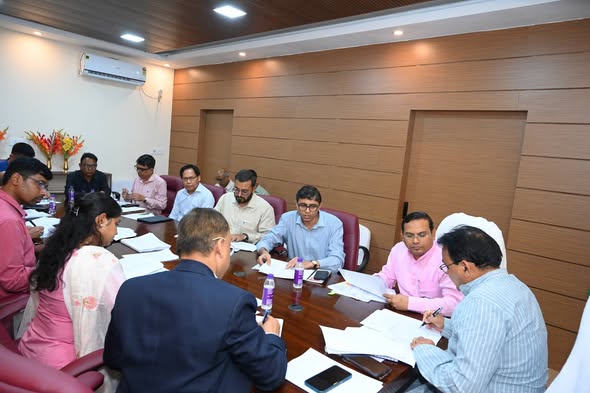
The meeting reviewed ongoing projects, infrastructure expansion plans, healthcare modernization efforts, and industrial growth proposals. Emphasis was placed on ensuring optimal fund utilization during the current financial year while laying a sustainable fiscal foundation for 2026–27.
Sector-Specific Deliberations with Cabinet Ministers
In a separate session, the Finance Minister held discussions with Industries and Commerce Minister Santana Chakma to assess sectoral allocations and industrial development targets for the upcoming fiscal year. The deliberations also covered skill development initiatives, jail administration, and welfare schemes for Other Backward Classes (OBCs).
Another meeting was convened with Minister of State for General Administration (Printing and Stationery) and Science, Technology and Environment Animesh Debbarma. The discussions centered on projected income, administrative expenditure planning, and technology-driven governance reforms aimed at enhancing efficiency and transparency.
Tribal Welfare and Minority Welfare Minister Sukla Charan Noatia also participated in a dedicated review session. The deliberations focused on department-wise development programs, welfare schemes for tribal and minority communities, and strategies to ensure targeted fund allocation under the Revised and Budget Estimates.
Emphasis on Education, Youth, and Rural Development
The Finance Minister further met Higher Education, Panchayat and General Administration (Political) Minister Kishor Barman to examine proposed allocations for educational institutions, rural governance frameworks, and administrative reforms.
In discussions with Youth Affairs and Sports, Social Affairs and Social Education, and Labour Minister Tinku Roy, the focus remained on expanding youth empowerment schemes, sports infrastructure, social welfare programs, and labor welfare measures. The meeting included a comprehensive evaluation of ongoing schemes, future expansion plans, and expected fiscal requirements.
Similarly, Tribal Welfare, Handloom, Handicrafts and Sericulture, and Statistics Minister Bikash Debbarma presented department-specific proposals aimed at boosting indigenous industries, promoting handloom and handicrafts, and strengthening statistical systems for better governance planning.
Transport, Tourism, Food, Civil Supplies and Consumer Affairs Minister Sushanta Chowdhury also joined discussions to review infrastructure expansion, tourism promotion strategies, and food security mechanisms.
Aligning Development with Fiscal Responsibility
Sources indicated that the series of meetings were aimed at ensuring that departmental proposals remain aligned with the state’s fiscal roadmap and long-term development vision. The Finance Department emphasized prudent expenditure management, enhanced revenue mobilization, and prioritization of people-centric initiatives.
The comprehensive consultations are expected to pave the way for a structured and balanced state budget, focusing on infrastructure growth, social sector development, industrial expansion, rural empowerment, and welfare-driven governance.
| Also Read: Crucial Pre-Budget meeting held on Transport and Tourism Allocations |
As the March 13 Budget Session approaches, the groundwork laid through these deliberations is likely to shape a fiscally disciplined and development-oriented Budget for 2026–27, reflecting the state government’s commitment to transparency, accountability, and inclusive progress.





