
A political storm over PM Modi’s Ladakh remark recalls Indira Gandhi’s 1971 crisis leadership, revealing how terse directives often empower decisive military action during national emergencies and shape India’s strategic responses.
No, this laconic order did not come from PM Modi, but from PM Indira Gandhi –read on.
Well, for the last few days one particular line from former Army Chief Gen. MM Naravane’s book ‘Four Stars of Destiny’ is making rounds and triggering political dust storms. The specific line was –Jo uchit lage woh karo.” (Do whatever you think right). This small instruction was given by Prime Minister Narendra Modi on August 31, 2020 night when the Chinese PLA tanks reportedly moved to Rechin La in eastern Ladakh and reached almost within 500 metres of the border.
The opposition, especially Congress, has found this terse and apparently ‘uncertain’ instruction tells about Prime Minister Modi’s –“indecisiveness” in the face of a crisis. But fact remains, often the political heads give enough indications of their intensions by laconic liners as to what should be done by the people in the field who are knowledgeable enough about ground realities. For one thing most importantly as to give them liberty as to how the tasks at hand should be handled. It is common in any democracy that the ‘political wisdom’ of the political heads restrains them from making detailed and elaborate order-sheet as it may more likely prevent the officers in the field to take time-demanded, unique and often daring and risk-filled decisions on their own. Apart from that such documented order sheets may also create or spark off unexpected and unnecessary controversy by the people who are not ‘adequately knowledgeable’ (Gen. Naravane’s own word) about that particular situation.
However, now the main point –is it PM Modi only gave such -one liner instruction in the face a grave crisis ? The Answer is NO. Does it show his indecisiveness? Perhaps, again NO.
In fact, Congress and its followers should know that such one liner instructions or small directives were Indira Gandhi’s favourite when such a situation arose. Indira Gandhi was mostly famous for her role in liberating Bangladesh in 1971 (and, infamous for Emergency).
It was when the Bangladesh crisis began on March 25-26 night (Operation Searchlight) , Pakistanis were killing Bengali citizens in thousands and East Pakistan’s Bengali officers revolted—the then BSF Chief and one of the brightest officers India has ever produced, K F Rustamji was asking for directions from the government . Genocides in East Pakistan shook the world , “Blood Telegrams” were sent and world was shocked. For India too the crisis was deepening fast and Rustamji was keen to extend support to the Bengali officers and others (political leaders -NAMs) . But there were delays from the centre. In the meantime a resolution on the Bangladesh issue was taken in the Parliament (March 31, 1971).
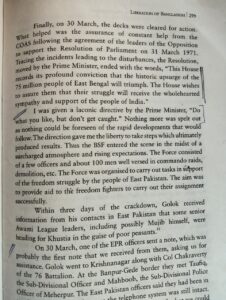
Anyway, as Rustamji was pursuing the government doggedly -at last PM Indira Gandhi gave her laconic direction: Do what you like , but don’t get caught”. (That was on March 30, 1971 just a day before the an unanimous resolution was taken in the Parliament).
Rustamji himself says : Nothing more was spelt out as nothing could be foreseen of the rapid developments that would follow. The directions gave me the liberty to take steps which ultimately produced results. Thus the BSF entered the scene in the midst of a surcharged atmosphere and rising expectations.
(The British, The Bandits and The Bordermen (published by Wisdom Tree : From the Diaries and articles of K F Rustamji , edited by PV Rajagopal))
In fact, Rustamji could foresee what was coming in Bangladesh long before others, perhaps except legendary RAW Chief R N Kao. And, as it happened, Rustamji was himself known for such terse orders ( uncannily similar to that of PM Gandhi’s later order). For example when the power transfer talks in Dhaka ( power to elected Sheikh Mujibar Rahaman) looked heading for a stalemate for certain ( before Mrach 25 Ops Searchlight) BSF DG Rustamji sent BSF IG Golak Majumdar from Delhi to BSF Eastern Sector to get prepared with three crisp instructions –1, Do whatever is necessary in national interest, 2. Follow your own methods and 3. Set your limits. Those instructions were given to remain prepared for engagement in the imminent Bangladesh Liberation War even before PM Indira Gandhi gave her green signal to the DG BSF for such engagement later.
“At exactly the same time India was in the midst of Parliamentary elections and hence clear directions were not forthcoming when the question arose as to how to meet the situation and what help, if any, could be given to the movement that was developing in East Pakistan “ ( P 293 The British, The Bandits and The Bordermen)
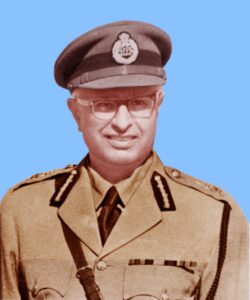
That was Khusro Faramurz Rustamji.
As for Tripura Rustamji sent Brig B C Pande to Agartala with his 104 commandos Battalion with verbal instructions to help Bangladeshi Liberation Forces. Similarly Col Rampal Singh ( 103 Commando Bn) was sent to Cooch Behar , Col Megh Singh ( 18 Commando BN) to Bongaon and Brig MS Chatterjee to Balurghat. It was on March 31 Brig Pande came to Agartala—the day Parliament was discussing the Bangladesh issue.
And then there is another very interesting ‘letter” of Indira Gandhi. It was written to the Tibetan E 22 ( or Special Frontier Force-SFF). These fighters were trained first by the CIA in Saipan ( first instructor was famous CIA guerrilla instructor Roger McCarthy and then in Colorado. They were taken from Mustang area to help CIA fight China. Later they came under Indian intelligence then IB under another legend B N Mullick. Forcer Odisha Chief Minister Biju Patnaik took the first initiative for this. Later the E-22/ SFF went under the RAW.
It was at the request of the first Indian E 22 commander IG Maj Gen SS Uban –who wanted to use the extremely capable and daring guerrilla fighters in the Liberation War -PM Indira Gandhi wrote to these Tibetan commandos : “We cannot compel you to fight a war for us. But the fact is that General A.A.K. Niazi (the Pakistan Army commander in East Pakistan) is treating the people of East Pakistan very badly. India has to do something about it. In a way, it is similar to the way the Chinese are treating the Tibetans in Tibet, we are facing a similar situation. It would be appreciated if you could help us fight the war for liberating the people of Bangladesh”.
(https://archive.thedailystar.net/suppliments/victory_day/2012/pg7.htm) . After they received the letter , the joined the Liberation War ( in November, 1971) before the war officially started on Dec 3, 1971 and virtually freed the CHT of not only Pakistanis but also the Mizo National Front, then holed up there.
| Also Read: Jackson Gate and the Story of an Untamed Firebrand |
| Also Read: The Forgotten Tail: The Vanished Plane Wreck from MBB College |
This brief letter is slightly expressive and explicit but the way it was written gives an idea as to often Political Heads give indirect orders.