The Tank that changed sides and then came home
Manas Pal
The Tank and the 105 mm artillery gun -Two silent war trophies in Agartala may tell an extraordinary story spanning the 1965 and 1971 Indo-Pak wars
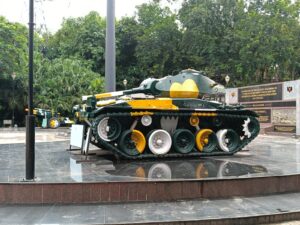
For decades, or to be precise since 1972, they stood amid the bustle of Post Office Chowmuhani in the heart of Agartala—a tank and an artillery gun, painted and repainted, familiar to generations of residents who passed them every day and then in 2020 they were transferred to the newly made war memorial complex named after Paramveer Lance Nayek Albert Ekka in the city.
Everybody knew, broadly, what they represented. They were Pakistani weapons captured during the 1971 Bangladesh Liberation War.
But few, perhaps, knew the extraordinary stories that may lie behind these two war machines.
We shall come to the 105 mm artillery gun later in second episode. First the tank.
(NEXT STORY WILL BE ABOUT THE 105 MM ARTI GUN THAT IS ALSO PLACED IN LN NK ALBERT EKKA WAR MEMORIAL PARK IN AGARTALA)
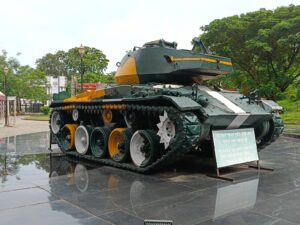
The tank that stood beside the gun in Post Office Chowmuhani and now at Albert Ekka Memorai Park presents an intriguing puzzle. It is perhaps the only tank in the world that was used by both the warring countries—here India and Pakistan both.
Studies reveal that it is a PT-76, the Soviet-designed amphibious light tank used extensively by the Indian Army.
That creates an obvious question: How did a Soviet made PT-76 become a Pakistani war trophy captured in East Pakistan? Pakistanis were not supplied with any such tank by the Soviets then.
The answer takes us back six years—to the 1965 Indo-Pak war. And the story is interesting.
A specialist study published in the US Army’s ARMOR magazine states that Pakistan’s 27 Infantry Brigade had a troop of PT-76s formed from four tanks captured from India in 1965 at Bedian ( Pakistan- Punjab). The same fact is recorded in armour histories of the 1971 campaign.
And 27 Brigade was precisely the Pakistani brigade that was defending Akhaura opposite Agartala in 1971.
Suddenly, the identity of the old Agartala tank becomes much more interesting.
A photograph dated 1966 shows soldiers of Pakistan’s 1st East Bengal Regiment entering Comilla in East Pakistan with a captured Indian PT-76. The accompanying historical description identifies the tank as having been captured from the Indian Army at Bedian, in the western theatre, during the 1965 war.
How could the Pakistanis capture the Indian tanks ?
The capture of the PT-76 tanks in this sector was primarily caused by critical training and technical deficiencies rather than direct tactical outmaneuvering: As highlighted in accounts from the US Army’s ARMOR Magazine, the 7th Light Cavalry received these tanks in late August 1965. When war broke out in early September, the crews had only a few days of familiarisation training. Crucially, the 76.2mm main guns had never been boresighted or zeroed at a firing range.
|Also Read : http://ciar.org/ttk/mbt/armor/armor-magazine/armor-mag.2001.mj/3pt76-01.pdf |
The Bedian Engagement: When the tanks entered combat in the Bedian sector to support the infantry, gunners quickly realized they could not accurately hit Pakistani targets because their optics and gun barrels were misaligned. Then under heavy artillery and counter-armor fire from the Pakistani defensive positions (which included the 1st East Bengal Regiment, known as the “Senior Tigers”), the structural disadvantages of the PT-76—such as its exceptionally thin, lightweight armor—became a major liability. With disabled tracks, bogged down in the terrain, or unable to accurately return fire due to un-zeroed weapons, four PT-76 tanks were abandoned by their crews and successfully seized intact by the Pakistani force
So Pakistani forces did not simply leave all the captured Indian PT-76s in West Pakistan. At least some were transported all the way across the subcontinent to East Pakistan.
By 1971, four captured Indian PT-76s had been organised into a troop associated with Pakistan’s 27 Brigade. Six years after being captured from India, those tanks were therefore waiting for the Indian Army again—this time on the eastern front. And the battlefield was Akhaura.
The fighting around Akhaura began even before the formal India-Pakistan war commenced on December 3.
Indian infantry ran into fierce resistance from Pakistani troops supported by armour. Then something extraordinary happened. Indian forces captured the Pakistani PT-76s.
The Government of India’s official history records that when Akhaura fell on December 5, among the Pakistani equipment captured were two PT-76 tanks.
Other participant-derived accounts give the number as three.
And those accounts provide another fascinating detail: the captured tanks were apparently repaired by Indian tank crews and immediately put back into action.
One account of the campaign describes the Indian advance towards Brahmanbaria riding on tanks commanded by “Shamsher”. It states that he now possessed 17 tanks—three more than his authorised establishment. The extra three were PT-76s captured at Akhaura, repaired and incorporated into his squadron.
The same account adds a delicious twist: only days earlier those very tanks had been firing at the Indian troops by the Pakistanis and now Indian soldiers are riding them towards Brahmanbaria and firing at the Pakistanis.
So the machines changed sides once again.
It was originally a soviet given Indian tank in 1965. It was captured by Pakistan and taken to East Pakistan.
It was used by Pakistan at Akhaura against Indians and then Indian soldiers captured. They repaired it and turned immediately against Pakistan.
But which one came to Agartala?
Here the historian has to separate an irresistible story from what can actually be proved.
There is no doubt about the identity of the vehicle that it is a PT-76.
There is also no doubt that the authorities regarded the tank and gun displayed there as captured 1971 war trophies.
Interestingly, historians can identify another captured Indian PT-76 that didn’t become the Agartala tank.
During the 1965 war, a PT-76 commanded by Major Chopra of 7th Light Cavalry became bogged down and could not be recovered. Indian troops demolished it before withdrawing. Pakistani East Bengal Rifles subsequently recovered the hull and preserved it as a trophy.
Then came another twist. In the 1971 war, 7th Light Cavalry recovered its own old tank at Chittagong and brought it back to its cantonment. The Indian Ordnance Corps subsequently collected the vehicle, while the Pakistani brass plaque commemorating its capture reportedly remained in the regiment’s officers’ mess. History demonstrates how these machines could cross borders, change armies and become trophies—sometimes more than once.
Meanwhile, the battle moved rapidly. Once Akhaura fell on December 5, the 57 Mountain Division was ordered to abandon its original objective and strike towards Brahmanbaria and Ashuganj.
The official history records 18 Rajput taking the bridge over the Titas, 4 Guards moving towards Sultampur and Pakistani forces abandoning positions while leaving considerable weapons and ammunition behind.
Pakistan’s own military history similarly records 27 Brigade withdrawing from the Brahmanbaria sector towards Ashuganj on December 6.
The offensive would soon become part of Sagat Singh’s audacious drive across the Meghna towards Dhaka.
Seen in that context, the two machines that eventually stood quietly at Post Office Chowmuhani were remnants of a battle fought virtually at Agartala’s doorstep.
For nearly half a century, Agartala children grew up seeing them. Office-goers hurried past them. Traffic circled around them. They became such familiar pieces of Agartala’s landscape that their individuality almost disappeared.
The tank beside has travelled a stranger road—from India to Pakistan, from West Pakistan to East Pakistan, from Pakistani hands back into Indian hands at Akhaura, and finally to Agartala.
The more appropriate epitaph for that old PT-76 would be : It went to war as an Indian tank, returned as a Pakistani trophy—and finally came home.
|Also Read : WHEN PAKISTANIS KILLED ONE OF OUR SITTING CHIEF MINISTERS WITH HIS WIFE https://tripuranet.com/when-pakistanis-killed-one-of-our-sitting-chief-ministers-with-his-wife.html |
(To be Continued) NEXT STORY IS ABOUT THE 105 MM ARTI GUN THAT IS ALSO PLACED IN LN NK ALBERT EKKA WAR MEMORIAL PARK IN AGARTALA
The Article was also published in the Tripura Times