
Centre targets Rs 2,000 crore turnover for Tripura’s agarwood industry as Union Minister Jyotiraditya Scindia lays foundation stone of Rs 80 crore processing cluster, boosting exports, farmer income, GI tagging and global market access.
The Union Government has set an ambitious target to expand Tripura’s agarwood industry turnover from the current Rs 100 crore to Rs 2,000 crore annually, Union Minister for Development of North Eastern Region (DoNER) Jyotiraditya Scindia announced on Saturday. The move is expected to transform Tripura into a global hub for agarwood-based products, significantly boosting employment, exports and rural incomes across the state.
Scindia made the announcement while laying the foundation stone of an Agarwood Cluster Common Processing Centre at Uttar Fulbari village in Kadamtala, located in North Tripura district. Addressing local residents, farmers and officials, the Minister highlighted agarwood’s extraordinary economic value, referring to it as “liquid gold” and noting that one gram of agar is more expensive than gold and silver in international markets.
The newly announced processing centre in Tripura, along with another similar facility planned at Golaghat in Assam, will be developed at a combined cost of Rs 80 crore. These Common Processing Centres (CPCs) are designed to ensure quality assurance, scientific processing, branding and global marketing of agarwood products, particularly fragrance and flavour derivatives such as agarwood oil, incense and premium perfumery ingredients.
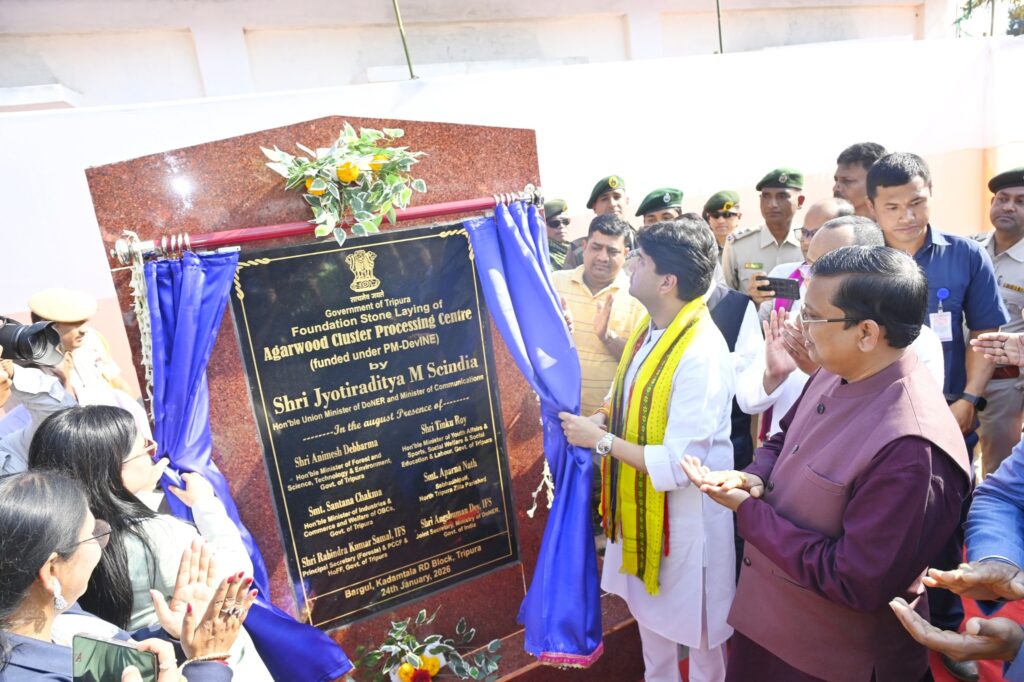
Scindia said the initiative aligns closely with Prime Minister Narendra Modi’s vision of developing the Northeast through locally driven industries under the “Vocal for Local” and “One District One Product” (ODOP) frameworks. He emphasised that Tripura and Assam already possess a natural advantage as India’s leading agarwood-producing states, and the new infrastructure will strengthen the entire value chain from plantation to export.
To enhance transparency and global credibility, the Centre will soon initiate the process for obtaining a Geographical Indication (GI) tag for Tripura’s agarwood. According to the Minister, the GI tag will ensure traceability of agarwood plantations, protect farmers’ interests and enhance international demand for authenticated products.
A major focus of the initiative is eliminating intermediaries in the agarwood trade. Scindia stated that all necessary permissions, plantation data and export documentation are being integrated into a digital platform, enabling farmers to directly access international buyers and receive fair prices for their produce.
The Minister also announced a major boost to export capacity. The export quota for agarwood oil has been increased sixfold, from 1,500 kg to 7,500 kg, while agarwood chip exports have been enhanced from 25,000 kg to 1.5 lakh kg. These reforms are expected to significantly improve India’s competitiveness in the global agarwood market.
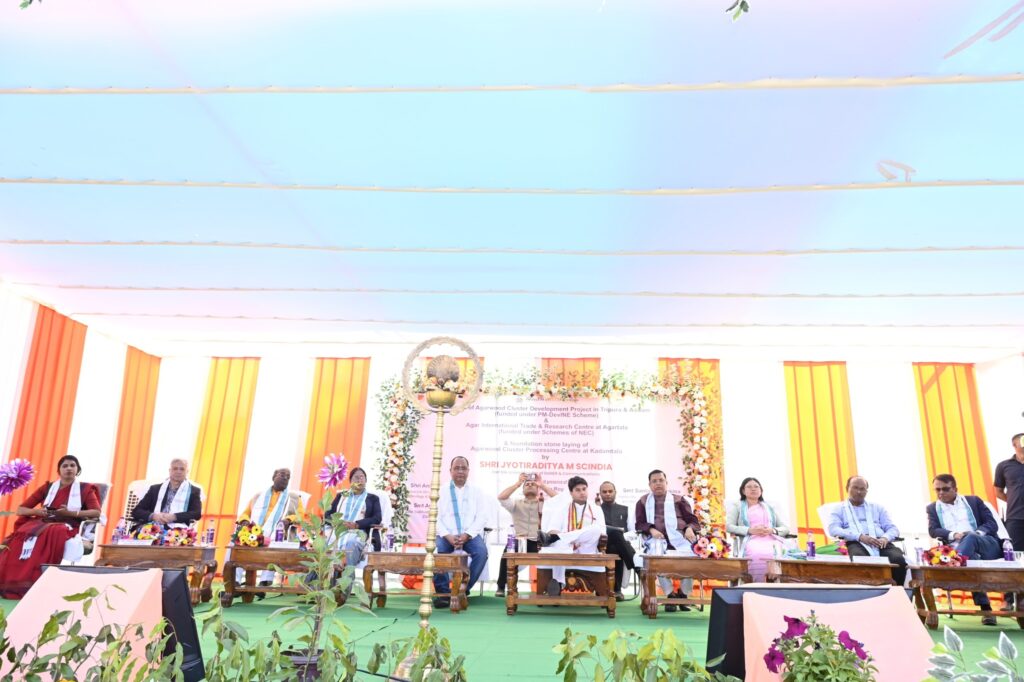
On the second day of his three-day visit to Tripura, Scindia visited the agar-cultivated village of Uttar Fulbari and interacted with local farmers and residents. He said buyer–seller meets are being organised to directly connect growers with international purchasers, citing recent engagements with buyers from Qatar as an example.
Tripura Chief Minister Manik Saha welcomed the Centre’s support and said the state government is implementing an integrated agarwood cluster under the Prime Minister’s Development Initiative for North East Region (PM-DevINE) at a cost of Rs 27.42 crore. The project includes nurseries, plantations, distillation units and skill development centres to strengthen the agar-based economy.
According to the Chief Minister, once operational, the integrated cluster is expected to benefit more than 7,000 people, with women and youth emerging as the primary beneficiaries. He pointed out that nearly 96 per cent of India’s agar trees are located in the Northeastern states and that Tripura has already been recognised as the country’s second-largest agarwood producer, with around 1.5 crore agar trees growing across the state.
CM Saha also informed that an agarwood market at Kadamtala in North Tripura is nearing completion, which will allow buyers and sellers to trade directly without middlemen. Additionally, an International Agar Trade and Research Centre is being developed with Rs 15 crore assistance from the North Eastern Council (NEC) to promote research, innovation and global trade.
| Also Read: Scindia’s Tripura visit boosts DoNER Infrastructure |
Adopted in 2021, the Tripura Agarwood Policy has already accelerated cultivation and processing activities. The state government expects the agar-based economy to reach Rs 2,000 crore within the next four to five years by promoting value-added products such as perfumes, premium incense sticks, agar-based spices and exports to high-end global markets.
Scindia expressed confidence that sustained collaboration between the Centre and the Tripura government would elevate the state’s agarwood sector to global prominence, setting a benchmark for self-reliant growth in the Northeast.