Chief Minister Manik Saha urges value-based, technology-driven education at TBSE Golden Jubilee, highlighting NEP reforms, digital learning, student welfare initiatives, and Tripura government’s efforts to strengthen moral values, skills, and educational infrastructure for future-ready students.
Chief Minister Dr Manik Saha on Thursday emphasized the need for a balanced education system that integrates moral values, spiritual grounding, and modern technology, asserting that such an approach is essential for shaping a purposeful and successful future for students. He said education should go beyond textbooks to nurture character, critical thinking, and real-world skills.
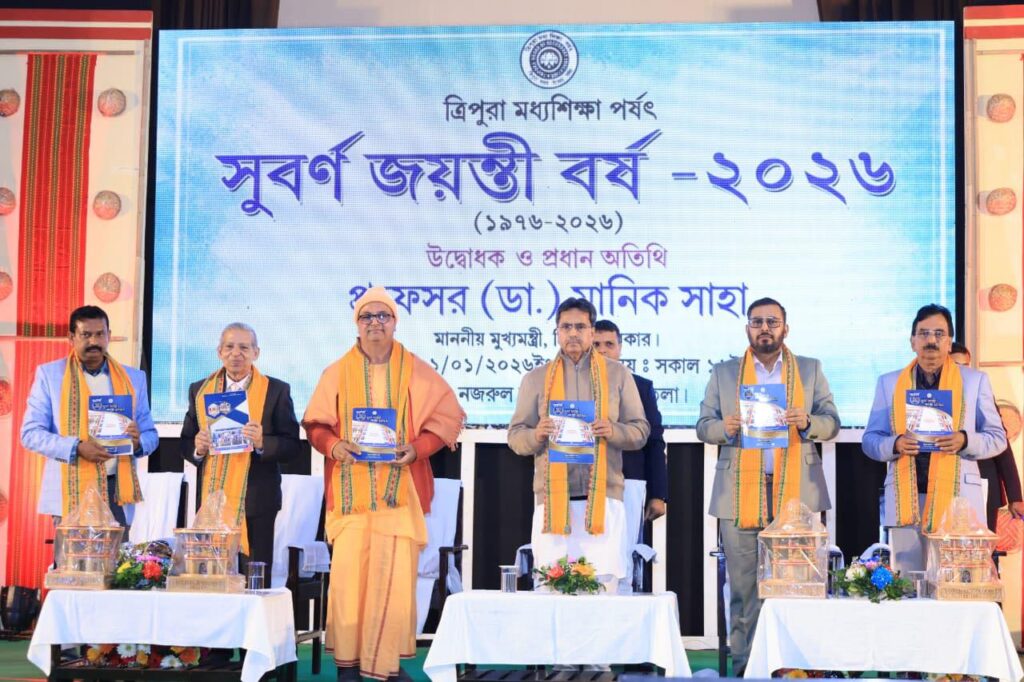
The Chief Minister was addressing the inaugural ceremony of the Golden Jubilee Year Celebration Festival of the Tripura Board of Secondary Education (TBSE) at Nazrul Kalakshetra in Agartala. The event marked 50 years of the board’s contribution to shaping secondary education in the state.
Speaking to students, teachers, and education administrators, Dr Saha said that true education is not limited to academic achievement alone. “For a successful future, students must acquire education enriched with moral values. Education helps individuals build a distinct identity in society and empowers them to contribute meaningfully to nation-building,” he said.
Highlighting the role of technology in modern learning, the Chief Minister urged students to harness digital tools and innovation to gain practical knowledge and hands-on experience. He said technology-driven education is no longer optional but a necessity in a rapidly changing global environment. According to him, blending academic learning with modern technology will equip students with skills required for emerging careers.
Dr Saha also underlined the importance of spiritual awareness in education, noting that spiritual practices help students remain calm, focused, and mentally balanced amid academic pressure and competition. He stressed that mental discipline and ethical values are crucial for long-term personal and professional success.
Referring to the National Education Policy (NEP), the Chief Minister said it was introduced under the leadership of Prime Minister Narendra Modi to modernize India’s education system and make it flexible, inclusive, and student-centric. He noted that the policy encourages multidisciplinary learning, skill development, and the use of technology to enhance teaching and assessment methods.
Dr Saha said educated youth are among India’s greatest strengths and that technology is now deeply integrated into education as part of the country’s vision to emerge as a global education hub. He added that the Tripura government is implementing multiple initiatives to ensure quality education reaches students on time and in an effective manner.
Recalling the journey of the Tripura Board of Secondary Education, the Chief Minister said the board was established in 1976 and has now reached a historic milestone by entering its golden jubilee year. He praised the board’s role in building a strong academic foundation for generations of students across the state.
Dr Saha stressed the importance of learning from the experience and dedication of former TBSE officers and staff to further strengthen the institution. He noted that since the implementation of the National Education Policy, academic performance in TBSE examinations has shown noticeable improvement and urged the board to take additional innovative steps to further enhance results and learning outcomes.
Highlighting key initiatives of the state government in the education sector, the Chief Minister mentioned programmes such as Nipun Tripura, Mission Mukul, and the Vidya Setu Module. He also referred to the distribution of bicycles to girl students to encourage school attendance and the ‘Super 30’ programme designed to support students aspiring for higher education and competitive examinations.
He informed that around 7,700 teachers across the state have undergone specialized training aimed at improving classroom delivery and student engagement. Smart classrooms have been introduced in many schools to integrate digital learning tools, he added.
Dr Saha further said that the government has opened new hostels for tribal students to ensure access to education in a supportive environment. A total of 47 hostels have been constructed under various schemes, including the PM Janman initiative. He announced that the state government aims to establish an Eklavya Model Residential School in each of Tripura’s 58 blocks to strengthen educational access for tribal communities.
The Chief Minister also spoke about the expansion of higher education infrastructure in the state, including the establishment of new colleges, universities, and technical institutions, to meet the growing aspirations of students.
| Also Read: Bangladeshi Publishers skip 44th Agartala Book Fair |
During the programme, 23 meritorious students were felicitated for their outstanding performance in secondary and higher secondary examinations between 2022 and 2025. Dr Saha personally presented certificates of recognition and released a commemorative souvenir marking the golden jubilee of TBSE.
In his concluding remarks, the Chief Minister said that just as Swami Vivekananda had established India’s identity on the global stage through his vision and values, Prime Minister Narendra Modi is working tirelessly to build a developed India that earns global recognition. He urged government employees and educators to rise above narrow interests and work with a spirit of service to shape the future of the state’s children.
The event was attended by Education Department Secretary Ravel Hemendra Kumar, Maharaj Swami Bhaktisudhananda of Viveknagar Ramakrishna Math, TBSE President Dhananjay Ganachowdhury, Board Secretary Joydeep Bhattacharya, and other senior officials and educationists.