


Tripura CM Dr. Manik Saha urged the Centre to enhance the EAP funding ceiling, provide a 40% natural gas rebate, operationalise Agartala–Chittagong flights, and accelerate key rail and road projects. He also proposed promoting the Northeast as India’s Green Industrial Hub and establishing a North East Industrial Free Trade Authority.
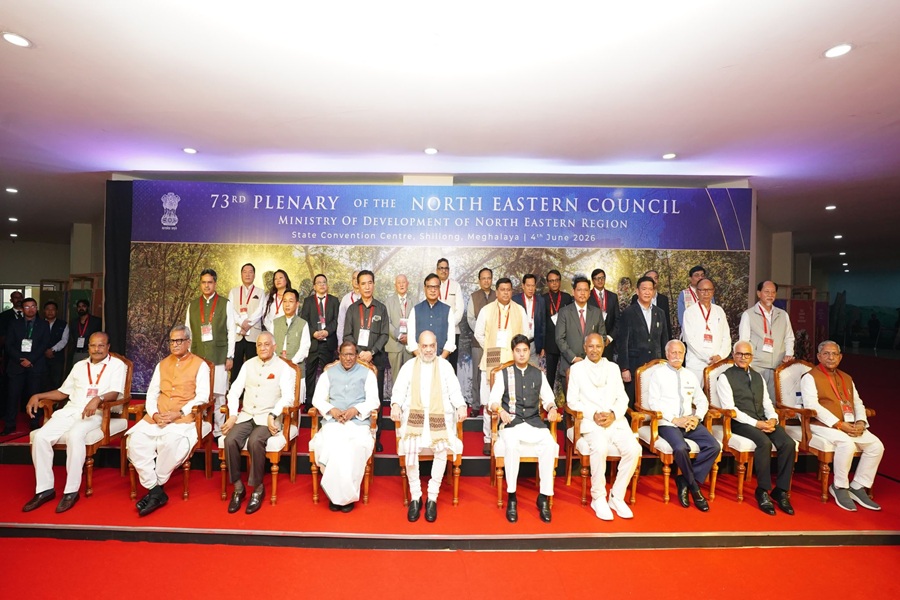
Tripura Chief Minister Dr. Manik Saha has strongly advocated for enhanced infrastructure investment, improved regional connectivity, and greater industrial development in Tripura and the Northeast during the 73rd Plenary Session of the North Eastern Council (NEC) held in Shillong.
Addressing the high-level gathering in the presence of Union Home Minister Amit Shah, Union Minister for Development of North Eastern Region (DoNER) Jyotiraditya Scindia, Minister of State for DoNER Sukanta Majumder, Chief Ministers and Governors of the Northeastern states, Dr. Saha placed a series of demands before the Centre aimed at accelerating the socio-economic transformation of Tripura.
Among the major proposals, the Chief Minister sought the operationalisation of direct Agartala–Chittagong flight services, early commencement of the Badarpur–Sabroom double-line railway project, and a 40 percent rebate in natural gas prices to boost industrial growth and economic activity in the state.
Dr. Saha also requested the Centre to enhance the funding allocation under the ‘Pride of Hills’ scheme from the existing Rs. 3,450 crore to at least Rs. 6,000 crore annually for Tripura. He further urged the Ministry of Finance to increase the ceiling for Externally Aided Projects (EAP) from the current Rs. 4,146 crore to Rs. 10,000 crore, enabling the state to secure funding for several developmental projects currently in the pipeline.
Highlighting the achievements of his government, Dr. Saha stated that Tripura has witnessed remarkable progress under the leadership of Prime Minister Narendra Modi and with the support of Union Home Minister Amit Shah.
According to the Chief Minister, Tripura’s Gross State Domestic Product (GSDP) has doubled over the past six years, while the state’s per capita income has reached parity with the national average. He noted that the state government has received more than 350 national and regional awards over the last eight years, reflecting the success of its development-oriented initiatives.
Dr. Saha also emphasized Tripura’s growing appeal as an investment destination. He informed the plenary session that the state attracted investments exceeding Rs. 30,000 crore during the past year. Of these, projects worth more than Rs. 8,000 crore have already been grounded and are progressing. He added that more than 200 startups have been recognized under the Tripura Startup Policy 2024, demonstrating the state’s growing entrepreneurial ecosystem.
The Chief Minister highlighted major improvements in healthcare infrastructure, stating that referrals of patients outside the state have reduced by nearly 80 percent due to enhanced medical facilities. He also pointed out that MBBS seats in Tripura have increased significantly from 225 to 550, while postgraduate medical seats have grown from 85 to 196 over the last four years.
On infrastructure development, Dr. Saha called upon the National Highways Infrastructure Development Corporation Limited (NHIDCL) to ensure quality road construction across the region. He requested priority four-laning of the Churaibari–Mugaikami, Agartala–Udaipur, and Udaipur–Amarpur highway stretches to strengthen transportation networks and facilitate economic growth.
The Chief Minister stressed the importance of improving air and rail connectivity in Tripura. Apart from direct Agartala–Chittagong flights, he sought extension of the runway at Agartala Airport and operationalisation of Kailashahar Airport under the UDAN scheme. He also urged the Centre to expedite the Badarpur–Sabroom double-line railway project, introduce electric passenger train services up to Sabroom, and launch a Vande Bharat Express service between Agartala and Guwahati.
Dr. Saha further requested the establishment of an All India Institute of Medical Sciences (AIIMS) in Agartala and sought approval for an Information Technology Park and a World Skill Centre under the PM-DevINE initiative. He noted that such institutions would significantly contribute to skill development, employment generation, and technological advancement in the state.
As Convener and Chairman of the High-Level Task Force on Investment Promotion in the Northeast, Dr. Saha also presented a broader vision for regional development. He outlined key sectors for investment, discussed challenges faced by Northeastern states, and proposed strategies to overcome them.
In a major policy recommendation, the Chief Minister advocated promoting the Northeast as India’s Green Industrial Hub, leveraging the region’s natural resources, renewable energy potential, and strategic location. He also proposed the creation of an Eastern Startup Corridor and the establishment of a North East Industrial Free Trade Authority to attract domestic and international investment.
Additionally, he recommended strengthening cross-border economic cooperation through cluster diplomacy, setting up a North East Skills University with campuses across all Northeastern states, promoting community-owned tourism models, and encouraging socially embedded investment frameworks that directly benefit local communities.
| Also Read: NEC, DoNER played key role in transforming NE into growth engine: Scindia |
On regional connectivity, Dr. Saha proposed coordinated multi-state planning mechanisms and the identification of high-impact infrastructure interventions supported by private sector participation. He stressed that stronger connectivity and integrated planning would be crucial for unlocking the Northeast’s full economic potential and ensuring sustainable development across the region.
The Chief Minister’s proposals underscore Tripura’s commitment to becoming a major growth engine in the Northeast while positioning the region as a strategic hub for industry, connectivity, tourism, and cross-border trade. His recommendations are expected to receive significant attention as the Centre continues to prioritize the development of the Northeastern states under its Act East and inclusive growth policies.





