

A Never Ending Journey : Bijoy Hrangkhawl’s Autobiography – What we miss
Autobiographies written by political and insurgent leaders often become more than personal narratives; they evolve into historical documents. They preserve memories, justify choices, shape public perception, and influence future generations’ understanding of turbulent periods. This is precisely why the recently released autobiography of Bijoy Hrangkhawl – A Never Ending Journey -carried enormous expectations.
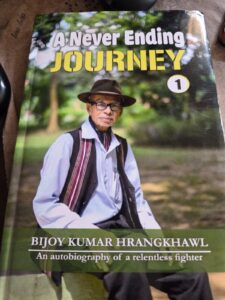
Hrangkhawl was not merely a politician. He was simultaneously a participant in electoral politics, an underground militant leader, a negotiator, a prisoner, and eventually a mainstream political figure. Few individuals in Tripura’s modern political history occupied so many contradictory spaces at once. Therefore, readers naturally expected an honest, detailed, and historically rich account of the decades surrounding the rise of tribal nationalism, the formation of the TNV, insurgency politics, ethnic conflict, negotiations, and eventual surrender.
Unfortunately, the autobiography falls far short of those expectations.
The central disappointment is not that the book contains factual errors alone, nor that it presents a partisan viewpoint—autobiographies often do. The real problem is what the book chooses to omit. Time and again, Hrangkhawl bypasses major events, key personalities, and decisive moments that defined both his life and Tripura’s political history. The silences are so frequent and conspicuous that the narrative often feels incomplete, selective, evasive and in a sense dishonest.
One of the earliest examples concerns the 1977 Lok Sabha election. Hrangkhawl briefly discusses the political activities of the TUJS and the movement for the TTAADC, yet entirely avoids mentioning his own participation in that crucial parliamentary election as a TUJS candidate against Maharaja Kirit Bikram Kishore Manikya Bahadur. The election result was politically devastating for him: the Maharaja secured 133,907 votes, Dasarath Deb received 120,724 votes, while Hrangkhawl managed only 13,255 votes. This defeat was not a minor episode; it effectively marked the collapse of his ambitions in conventional electoral politics and preceded the formation of the TNV. Omitting such a transformative political setback leaves a major gap in the narrative.
The treatment of the TNV years is similarly sketchy. Readers expecting a serious account of the organization’s structure, operations, ideological evolution, and internal dynamics will find surprisingly little. One striking omission is the near-total absence of Chuni Koloy, a key TNV militant leader and army chief remembered by many contemporaries. Hrangkhawl mentions him only once in passing, recalling him carrying books for schools established by him. Beyond that, Koloy—despite his central operational role—virtually disappears from the autobiography.
This selective silence extends to many founding members and influential figures associated with the TNV, including Dhananjay Reang, Kartik Koloy, Kamini Debbarma, and Ananta Debbarma. Except for a passing mention regarding Ananta Debbarma’s marriage to a woman militant, these figures receive little or no meaningful discussion, despite their involvement in major militant operations and organizational development.
The chronology of the TNV’s formation and revival also raises confusion. Hrangkhawl states that the first secret meeting of the TNV took place on October 10, 1978, at Kasiko Kami. Earlier understandings generally placed this meeting on December 21, 1978, though readers may accept Hrangkhawl’s date as authoritative. Yet inconsistencies emerge when he later discusses his six months underground and simultaneously refers to his famous meeting with Chief Minister Nripen Chakraborty during a solar eclipse day in 1978.
This creates a chronological problem. The two solar eclipses in 1978 occurred on April 7 and October 2—both preceding the alleged October 10 TNV meeting. Independent research instead suggests the meeting occurred on August 22, 1979, during a full solar eclipse, which aligns much more logically with the timeline of his underground activities and with Hrangkhawl’s own earlier statement published in Tripura Star on March 30, 1980. Such inconsistencies are significant because the book presents itself as historical testimony.
Equally notable is the vague treatment of the ATPLO episode. Hrangkhawl narrates his abduction by Binanda Jamatia’s ATPLO on August 13, 1982, and mentions being entrusted with financial responsibilities within the organization. However, he entirely avoids explaining how and why Chuni Koloy’s TPLA subsequently re-kidnapped him from ATPLO custody, leading to the revival of the TNV on November 10, 1982. Likewise absent is any substantial discussion of the TNV’s later assaults on ATPLO, which eventually forced Binanda Jamatia and his organization to surrender in June 1983.
The autobiography also touches only superficially on Hrangkhawl’s links with the Mizo National Front. He briefly mentions meeting MNF leader Laldenga in New Delhi but offers almost no insight into how or why the MNF decided to support the TNV. Given the geopolitical and insurgent networks of Northeast India during that period, this relationship was historically important and deserved fuller explanation.
Perhaps the most glaring omission concerns the communal violence of the 1980s. Although Hrangkhawl discusses the political atmosphere of the period, the book largely glosses over the infamous ethnic riots that deeply scarred Tripura’s social fabric. He merely states that the government acted in a biased manner against tribals and that he and other leaders were arrested. There is little attempt to critically examine the violence itself, the role of militant groups, or the wider humanitarian consequences.
Similarly evasive is the discussion surrounding negotiations with former Prime Minister Rajiv Gandhi. Hrangkhawl writes about his friendship with Rajiv Gandhi but avoids discussing the understanding reportedly reached through Lalthanhawla regarding the TNV’s proposed surrender. Consequently, the autobiography also sidesteps one of the darkest episodes associated with the period—the large-scale killing of Bengali civilians shortly before the 1988 elections, when 117 Bengalis were reportedly massacred in January 1988. The silence surrounding this issue is impossible to ignore.
Another weakness of the book lies in its selective operational history. Hrangkhawl offers brief descriptions of jungle life, camp movement, hunting experiences, and the functioning of TNV camps, but leaves out many key operations. There is no detailed account of the first TNV operation at Bagabil TAP camp on July 2, 1980, where eight rifles were looted—an operation widely regarded as historically significant in the organization’s armed rise. Likewise absent is any substantial discussion of earlier attacks such as the Tamakari village incident at Prabhat Debbarma’s Dalanbari.
The autobiography’s handling of historical facts occasionally creates further confusion. Hrangkhawl claims that both Congress and the Left Front, including the GMP, opposed the creation of the ADC. He writes that the GMP considered the ADC demand illogical and infeasible. This assertion by all intents and purposes stands historically incorrect and may require the readers for deeper re-examination against contemporary political records.
There are also smaller inaccuracies and discrepancies. At one point Hrangkhawl states that the third Left Front government came to power in 1995, though it actually returned in 1993. Such mistakes may arise from age-related memory lapses or editorial oversight, but in a political autobiography they weaken confidence in the chronology.
The book also conspicuously avoids mentioning Bangladesh, despite the fact that Hrangkhawl reportedly took shelter there with MNF assistance. There is similarly no reference concerning his alleged visit to Pakistan in April 1985 with two ISI officials for arms procurement. The travel was reported by The Telegraph on January 30, 1986 based on a revelation made to Indian diplomats in Dhaka by some authoritative sources. Whether denied or explained, these allegations formed part of the historical discourse surrounding the insurgency and deserved acknowledgment.
Yet, despite all these criticisms, the autobiography is not entirely without value. Hrangkhawl’s descriptions of tribal grievances, land alienation, exploitation through money lending, and displacement reflect realities that undeniably shaped tribal political consciousness in Tripura. While some interpretations may appear repetitive or exaggerated, the emotional and political foundations of those grievances remain historically important.
The book also provides glimpses into prison life, underground existence, and the psychology of insurgency leadership. His accounts of detention and confinement are among the more compelling sections, though even here some omissions are noticeable—for example, the lack of discussion regarding his confinement in Kamalpur jail after arrest.
Ultimately, the autobiography disappoints not because it lacks drama, but because it withholds too much of it. Readers expected candour from a disciplined and deeply ideological man who occupied the centre of some of Tripura’s most consequential political and militant developments. Instead, the narrative often feels carefully controlled, selective, and incomplete.
An autobiography, especially from a figure like Bijoy Hrangkhawl, carries historical responsibility. It should illuminate difficult truths rather than merely reinforce familiar narratives. What emerges from this book is less a comprehensive memoir and more a partial political recollection shaped by omission and caution.
For historians, political observers, and readers interested in Tripura’s turbulent past, the autobiography remains important—but perhaps more for what it leaves unsaid than for what it actually reveals.
(We cannot expect in the proposed second volume he will go for details as in the book itself Hrangkhawl outlined his subjects- Folk stories and songs, traditional and historical events, traditional governance, customary laws etc.)
|Add : Tripura CM Praises Somnath as Symbol of India’s Resilience |





