
Honest consumer pays for lost units, the TSECL story
- The raging controversy over smart electricity meters and allegedly inflated power bills in Tripura has brought an uncomfortable question to the centre of the debate: when the electricity distribution system suffers heavy technical and commercial losses—for hookline theft or inefficient management- who ultimately pays for the power that is generated but never properly billed or collected for? Tripura’s transmission and distribution loss is 28.70 per cent. It represents a major efficiency challenge for the electricity distribution system. Separately, the reported 18.23 per cent AT&C loss points to another layer of inefficiency involving both technical and commercial aspects. It is in this backdrop one would certainly say, the honest consumer should not become TSECL’s easiest source of revenue simply because that consumer is identifiable, metered and accessible.
The point assumes greater significance in view of Tripura’s exceptionally high transmission and distribution (T&D) losses.
According to data furnished by the Union Ministry of Power, Tripura recorded 28.70 per cent T&D losses in 2023-24, substantially higher than the national average of 17.63 per cent.
In simple terms, nearly 29 units out of every 100 units entering the transmission and distribution network are accounted for as losses before reaching the point of consumption. Not all such losses are due to theft. A part is attributable to technical factors such as resistance in lines, transformers and other network equipment. But the larger issue is that the distribution system also has to contend with electricity theft, unauthorised connections, meter-related irregularities, billing inefficiencies and non-payment of legitimate bills.
Tripura’s own Energy Vision 2030 has acknowledged the seriousness of the problem, identifying ageing infrastructure, overloaded transformers, inadequate preventive maintenance and low billing efficiency among the factors contributing to high losses. The document had noted that AT&C losses in several divisions remained high.
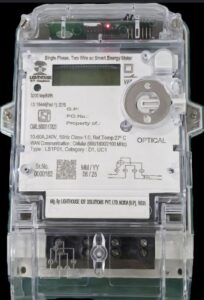
Against this backdrop, the introduction of smart meters is being presented as an important instrument for improving energy accounting, detecting theft and strengthening revenue collection. Indeed, smart metering is intended to make electricity consumption more transparent by enabling utilities to monitor consumption and identify high-loss areas and defaulting consumers. The Centre has itself identified prepaid smart meters and system metering as important interventions for reducing distribution losses and improving energy accounting.
But this is precisely where the present public anger over smart meters raises a larger issue.
Can a consumer who pays every electricity bill on time be made to bear the financial burden created by somebody else’s theft, somebody else’s unpaid bill or inefficiencies within the distribution system?
That question cannot simply be dismissed as opposition to technological modernisation. If a household has no unauthorised connection, does not manipulate its meter, consumes electricity within its normal requirement and pays every bill regularly, it has already fulfilled its obligation as a consumer. The responsibility for preventing theft, maintaining the network, ensuring accurate billing and recovering legitimate dues lies primarily with the distribution utility.
The controversy becomes sharper when smart meters suddenly become the most visible mechanism for revenue recovery. Consumers are naturally asking whether the objective is merely to measure their consumption more accurately — or whether the technology is also being used to recover accumulated losses from the system by squeezing the section of consumers that is easiest to identify and collect from.
There is an important distinction here.
Recovering the actual electricity consumed by a consumer is legitimate. Recovering from that consumer the cost of electricity stolen by somebody else is an entirely different proposition.
The same applies to unpaid bills. If thousands of consumers default on their electricity payments, the answer cannot logically be to make the consumers who pay regularly compensate for the default through unexplained or disputed billing.
This is where TSECL’s loss figures demand greater public scrutiny.
Tripura’s 28.70 per cent T&D loss is not a trivial accounting number. It represents a major efficiency challenge for the electricity distribution system. Separately, the reported 18.23 per cent AT&C loss points to another layer of inefficiency involving both technical and commercial aspects.
These figures should therefore prompt a more fundamental question: how much of the financial burden of these losses is being absorbed by the utility, how much is being recovered through tariffs, and how much ultimately gets reflected in the bills of paying consumers?
 The
The
re is also a question of transparency.
TSECL should publicly disclose, preferably subdivision-wise, the quantum of electricity entering the network, electricity actually billed, electricity actually collected for, technical losses, assessed theft, unbilled consumption and outstanding dues. Without such an energy-accounting trail, the ordinary consumer has little means of knowing whether a rising bill reflects genuine consumption, tariff changes, improved metering — or the cost of inefficiencies elsewhere in the system.
The irony is difficult to miss.
For years, consumers could complain that electricity theft was taking place through crude methods such as direct hooking of lines. Now, with smart meters capable of recording consumption with far greater precision, the honest consumer is being told that the system is becoming more accountable.
That accountability, however, must operate in both directions.
If smart meters are genuinely intended to create a more efficient electricity system, they should not merely become instruments for recovering money from consumers. They should also enable TSECL to identify theft-prone feeders, locate abnormal consumption, detect distribution losses, identify chronic defaulters and establish exactly where electricity is disappearing.
The technology exists. The question is whether the institutional will exists to use it equally against theft, technical inefficiency and commercial leakage.
There is another issue that cannot be ignored. TSECL itself has previously confronted allegations of underbilling. In July 2025, amid protests over smart meters and high bills, the corporation issued a show-cause notice to a billing agency, alleging that average bills had been submitted for consumers with functioning meters and that this had caused financial loss to TSECL.
In July 2025, amid protests over smart meters and allegations of exorbitant bills, TSECL issued a show-cause notice to a private billing agency after alleging that average bills had been submitted for consumers despite the presence of functioning meters. TSECL said the practice had resulted in consistent underbilling and direct financial loss to the corporation.
The episode is revealing.
If TSECL itself can lose revenue because consumers with functioning meters are not billed according to actual consumption, then the problem is not simply that consumers are resisting accurate metering.
There can also be failures inside the billing and revenue-collection system.
TSECL’s own tender conditions underline the importance of accurate meter reading. The corporation’s contractual provisions provide for penalties where bills are not commensurate with actual meter readings and for failure to upload meter-reading photographs.
Therefore, the public debate should not be reduced to:
“Smart meters are accurate; therefore, consumers should not complain.”
Accuracy of a meter and accuracy of the entire billing ecosystem are two different questions.
A meter may accurately record consumption. But consumers also need confidence that the data is correctly transmitted, processed, billed, credited and reconciled.
And when a consumer disputes a bill, there must be an accessible mechanism to establish exactly what happened.
That episode underlines why consumers are demanding greater transparency today.
The public is not necessarily questioning the principle of smart metering. What many consumers are questioning is whether the burden of making TSECL financially healthier is being placed disproportionately on those who are already paying.
The basic economics of electricity distribution cannot be avoided.
Power has to be generated or procured, transmitted, distributed and ultimately paid for. When a portion of the electricity disappears through technical losses, theft or non-payment, somebody bears the cost.
But the most convenient payer should not automatically become the most responsible payer.
If TSECL wants consumers to accept smart meters as a symbol of modernisation, it must demonstrate that the meters are part of a larger campaign to eliminate theft, recover arrears, reduce technical losses, improve billing accuracy and make the distribution system more efficient.
Otherwise, the smart meter controversy risks becoming a much larger question than the amount appearing on an individual electricity bill.
It becomes a question of who pays for an inefficient electricity system.
Do honest consumers subsidise dishonesty? This is perhaps the most politically uncomfortable question of all.
Suppose a household pays every bill without fail.
It does not steal electricity.
It does not manipulate its meter.
It does not have an unauthorised connection.
It has no outstanding arrears.
Why should such a consumer be concerned about the distribution utility’s losses?
The answer is obvious: because the electricity system is interconnected, and its financial health eventually affects every consumer.
But that creates an obligation on the utility as well.
The honest consumer should not become TSECL’s easiest source of revenue simply because that consumer is identifiable, metered and accessible.
And the question that TSECL must answer is a simple one: Why should the consumer who pays every bill on time be made to carry the cost of the consumer who steals electricity, the consumer who does not pay, and the losses that the distribution system itself has failed to prevent?
Also read https://tripuranet.com/high-power-bills.html
Published in Tripura Times also.