


Tripura launches a transformative Higher Education Dialogue led by Education Minister Kishor Barman, targeting 75% higher education participation by 2030 through world-class campuses, modern infrastructure, digital learning, sustainable development, and student-focused reforms aligned with the vision of a Developed India.
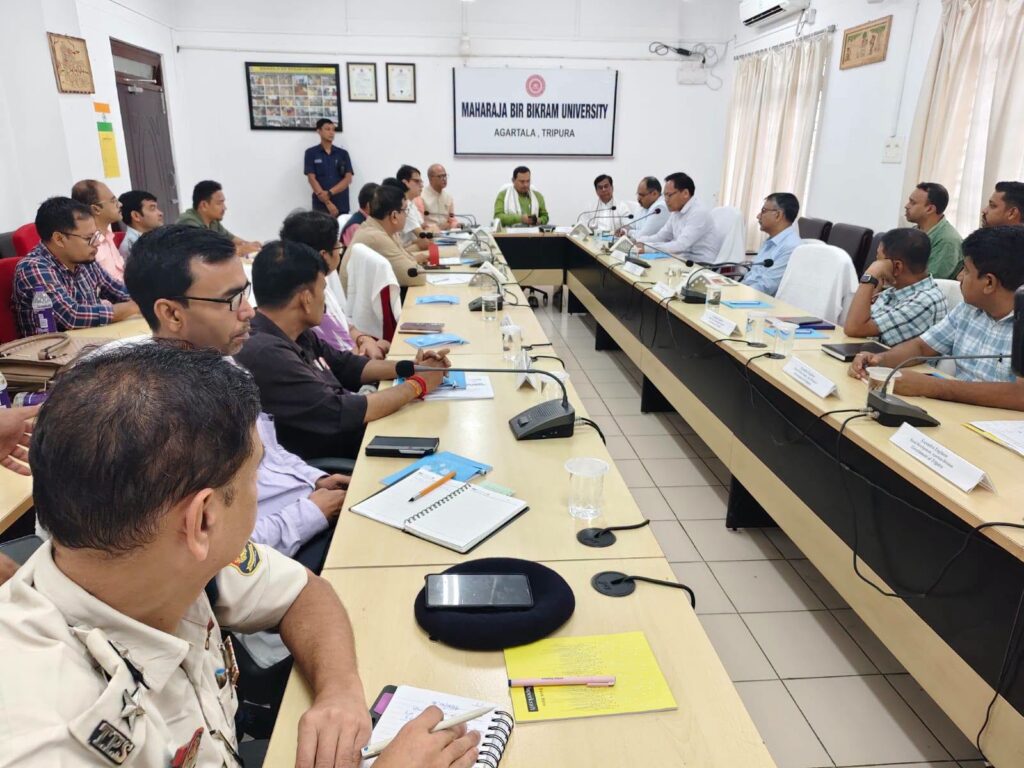
In a landmark initiative aimed at transforming the higher education landscape in Tripura, Higher Education Minister Kishor Barman announced an ambitious roadmap to increase the state’s higher education participation rate from the present 22 percent to 75 percent by 2030. The announcement was made during the Ucchasiksha Sanglap (Higher Education Dialogue) held at the conference hall of Maharaja Bir Bikram (MBB) University, where senior government officials, education administrators, teachers, students and representatives from various institutions gathered to discuss the future of higher education in the state.
The dialogue focused on the comprehensive development of the integrated education campus comprising Maharaja Bir Bikram University, MBB College, BBMC College and Law College. The meeting emphasized modern infrastructure, digital transformation, sustainable development, campus safety, research opportunities and the creation of a student-friendly academic environment capable of meeting global standards.
Addressing the gathering, Minister Kishor Barman said the state’s mission is to create a world-class higher education ecosystem that will contribute significantly to Prime Minister Narendra Modi’s vision of a Developed India (Viksit Bharat). He stated that raising enrolment to 75 percent by 2030 would require collective efforts from students, teachers, administrators, policymakers and society as a whole.
“Our objective is not merely to construct better buildings but to establish campuses that promote quality education, innovation, research, discipline, environmental sustainability and technological advancement. Every stakeholder has a role in achieving this vision,” the Minister said.
Describing the Higher Education Dialogue as more than just an administrative review meeting, Barman called it the beginning of a new culture of participatory governance in education. According to him, the initiative opens the doors for constructive suggestions and active involvement from faculty members, students, non-teaching staff, administrative officials and the public in shaping future educational policies.
The Minister identified MBB University, MBB College, BBMC College and Law College as model institutions that will spearhead this transformation. These campuses are expected to witness significant improvements in academic infrastructure, smart classrooms, digital learning facilities, libraries, laboratories, green spaces, security systems and student amenities over the coming years.
Highlighting the importance of student participation, Barman said regular classroom attendance and active use of institutional facilities such as libraries, laboratories and canteens should be encouraged and considered while framing student-centric policies. He emphasized that reforms in higher education cannot succeed unless students remain at the centre of every decision-making process.
The Minister further announced that similar Higher Education Dialogue programmes would soon be organized across every district in Tripura. These meetings will help identify institution-specific challenges and encourage local authorities to resolve routine administrative issues without unnecessary delays. He noted that decentralised decision-making would improve efficiency and strengthen institutional governance.
During the dialogue, discussions also centred on effective implementation of the National Education Policy (NEP), expansion of digital education, adoption of modern teaching methodologies, creation of clean and green campuses, installation of solar lighting systems, anti-drug awareness programmes involving students, and coordination with the Power and Horticulture Departments to improve campus infrastructure and environmental sustainability.
In another significant announcement, Minister Barman confirmed that the state’s proposed Technical University and Women’s University, both of which have already received approval from the State Assembly and the Governor, are expected to commence academic activities soon through student admissions. He added that the proposed Medical University would be established following a decision by Chief Minister Dr. Manik Saha.
| Also Read: Tripura adopts AI for better student learning outcomes |
The programme witnessed the participation of Agartala Municipal Corporation Mayor Dipak Majumder, Higher Education Secretary Vikas Singh, Director of Higher Education Animesh Debbarma, West Tripura District Magistrate Dr. Vishal Kumar, MBB University Vice-Chancellor, Registrar Sumanta Chakraborty, principals of participating colleges, faculty members, non-teaching staff and senior government officials.
The event concluded with a tree plantation drive on the MBB University campus, symbolising the government’s commitment to environmental sustainability alongside academic excellence.
| Also Read: Tripura Govt Postpones New Universities Over Infrastructure Shortage |
Reiterating his vision, Minister Kishor Barman said that the 2030 target is not simply about improving enrolment figures but about building educational institutions that inspire innovation, nurture talent, promote research, uphold human values and prepare the youth of Tripura to compete globally. He expressed confidence that through collective responsibility and sustained reforms, Tripura’s higher education institutions would emerge as centres of excellence, contributing meaningfully to the state’s socio-economic development and India’s journey towards becoming a developed nation.





