


Tripura Agriculture Minister Ratan Lal Nath inaugurated the Betchara Rural Market in Kumarghat, highlighting MSP procurement, farmer subsidies, modern infrastructure, PM-KISAN benefits, rural development, and improved agricultural growth while unveiling projects worth over Rs 15 crore to strengthen the state’s rural economy.
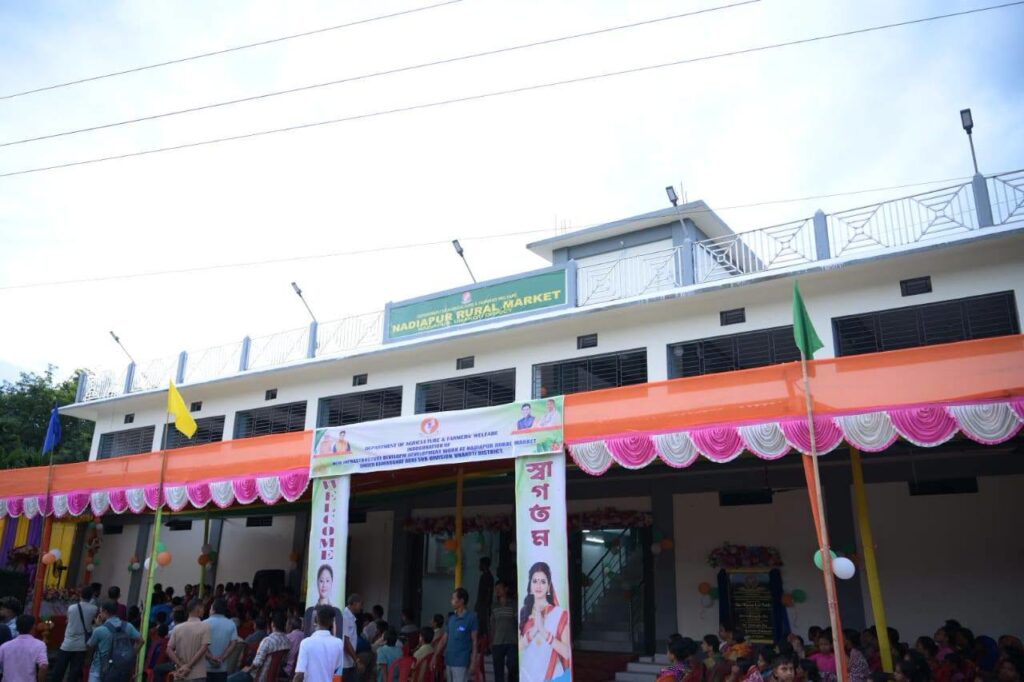
Tripura’s rural economy received another significant boost with the inauguration of the Betchara Rural Market in Kumarghat subdivision of Unakoti district, as Agriculture and Farmers’ Welfare Minister Ratan Lal Nath reaffirmed the government’s commitment to strengthening agriculture through minimum support price (MSP) procurement, modern infrastructure, subsidies, and farmer-centric welfare schemes.
The newly inaugurated rural market, constructed at a cost of Rs 2.20 crore, is expected to become an important trading hub for farmers by providing them with better access to markets, ensuring fair prices for agricultural produce, and reducing dependence on intermediaries. The facility is designed to create a structured environment for rural commerce while promoting agricultural entrepreneurship across the region.
Addressing a gathering during the inauguration ceremony, Nath, who also serves as the state’s Power Minister, said that agriculture remains the backbone of Tripura’s economy and that sustained government investment in infrastructure and farmer welfare has transformed the rural landscape over the past eight years.
The minister emphasized that the present government has prioritized ensuring remunerative prices for farmers through MSP procurement. According to official figures shared during the event, more than 2.72 lakh tonnes of paddy have been procured from over 1.40 lakh farmers, with payments totaling Rs 546.39 crore directly benefiting cultivators.
Highlighting the government’s efforts to modernize agriculture, Nath said mechanization has played a crucial role in increasing productivity and reducing the burden on farmers. He noted that while previous administrations distributed only 2,611 agricultural machines, the current government has provided 50,089 modern agricultural machines with subsidies amounting to Rs 233.63 crore.
“Our farmers are now equipped with technology, financial support, and market access that were once unimaginable. The objective is not only to increase production but also to improve farmers’ income and make agriculture more sustainable,” Nath said.
The minister also highlighted the impact of several flagship Central Government schemes that have strengthened Tripura’s agricultural sector. Under the PM-KISAN scheme, 2,85,571 farmers have received financial assistance totaling Rs 1,021 crore through 23 installments, providing direct income support to farming families.
Similarly, the Kisan Credit Card (KCC) scheme has enabled 4,57,170 farmers to access agricultural loans worth Rs 2,711 crore, ensuring easy availability of institutional credit for cultivation and allied activities.
Nath further pointed out that the Pradhan Mantri Fasal Bima Yojana (PMFBY) has made crop insurance significantly more affordable. The insurance premium, which previously stood at approximately Rs 220 per kani, has now been reduced to just Rs 10, allowing more farmers to safeguard their crops against natural calamities and unforeseen losses.
Beyond agriculture, the minister presented a broader picture of Tripura’s socio-economic transformation, citing improvements in income levels, housing, drinking water supply, and food security.
He said the state’s per capita income has nearly doubled, rising from Rs 1.04 lakh to Rs 1.98 lakh, reflecting the growing economic strength of rural households. Housing infrastructure has also witnessed remarkable progress, with the number of pucca houses increasing from around 78,000 to nearly five lakh, while another 2.5 lakh houses have already been sanctioned.
Access to clean drinking water has expanded dramatically over the years. Nath stated that piped water connections have increased from just 24,000 households to 6.22 lakh households, significantly improving public health and living conditions across rural Tripura.
Food security remains another key focus area, with 24.76 lakh beneficiaries receiving 5 kilograms of rice per person every month, ensuring affordable food availability for economically weaker sections.
Infrastructure development has also contributed significantly to agricultural growth and rural connectivity. Nath noted that the state’s national highway network has expanded from 199 kilometres to 923 kilometres, improving transportation of agricultural produce and facilitating faster access to markets.
He further highlighted that farmers’ average monthly income has increased from Rs 6,580 in 2015-16 to Rs 13,590, attributing the growth to improved market access, government support, modern farming techniques, and infrastructure development.
The minister also stressed Tripura’s growing emphasis on sustainable agriculture. Natural farming, which had virtually no presence in the state a few years ago, now involves 42,000 farmers cultivating nearly 16,800 hectares of land using environmentally friendly agricultural practices.
To strengthen institutional support for farmers, the government has established 34 Krishak Bandhu Kendras and 59 Farmer Producer Organisations (FPOs), providing technical guidance, collective marketing opportunities, and better access to agricultural inputs.
Apart from inaugurating the Betchara Rural Market, Nath also inaugurated and laid foundation stones for four additional development projects worth over Rs 15 crore. These include the new office building of the Kumarghat Electrical Division constructed at a cost of Rs 5.97 crore, the Susangata Seed Processing Centre at Jagannathpur worth Rs 1.87 crore, and the Deputy Director of Agriculture (Horticulture) and Soil Conservation Office at Kumarghat built at a cost of Rs 2.79 crore.
| Also Read: CPI(M) Secy lays Jagannath Temple foundation stone |
Concluding his address, Nath said Tripura has made notable progress in ensuring food security, healthcare, education, and rural development. He expressed confidence that continued investments in agriculture, infrastructure, and welfare initiatives would further improve the quality of life for citizens.
“Tripura today has no shortage of food, healthcare has improved, education is progressing, and life expectancy is increasing. Our target is to achieve a life expectancy of 74 years in the near future and reach 80 years by 2030. Our vision is to build a prosperous and dignified future for every citizen of the state,” the minister said.





