


Union Home Minister Amit Shah opposes foreign script for Kokborok in Tripura, strongly backing Nagari to protect indigenous identity. At Agartala Rajbhasha Sammelan, he calls for linguistic unity, mother tongue education, and cultural self-reliance across Northeast India.
In a decisive intervention in the ongoing Kokborok script debate, Union Home Minister Amit Shah signalled the Centre’s firm opposition to adopting any foreign script for indigenous Indian languages. Speaking at the Joint Regional Official Language Conference (Rajbhasha Sammelan) in Agartala on Friday, Shah strongly advocated the use of Nagari for languages and dialects that do not yet have an established writing system.
His remarks are widely viewed as a clear message amid the political and cultural debate in Tripura over the script to be used for Kokborok, the language spoken by a significant section of the state’s indigenous population.
“Script Rooted in Indian Soil”
Delivering the inaugural address, Shah asserted that the true identity of any ethnic community can be preserved only when its language is written in a script “rooted in Indian soil rather than those of foreign origin.” Without directly naming Roman script, he virtually ruled out its introduction for Kokborok.
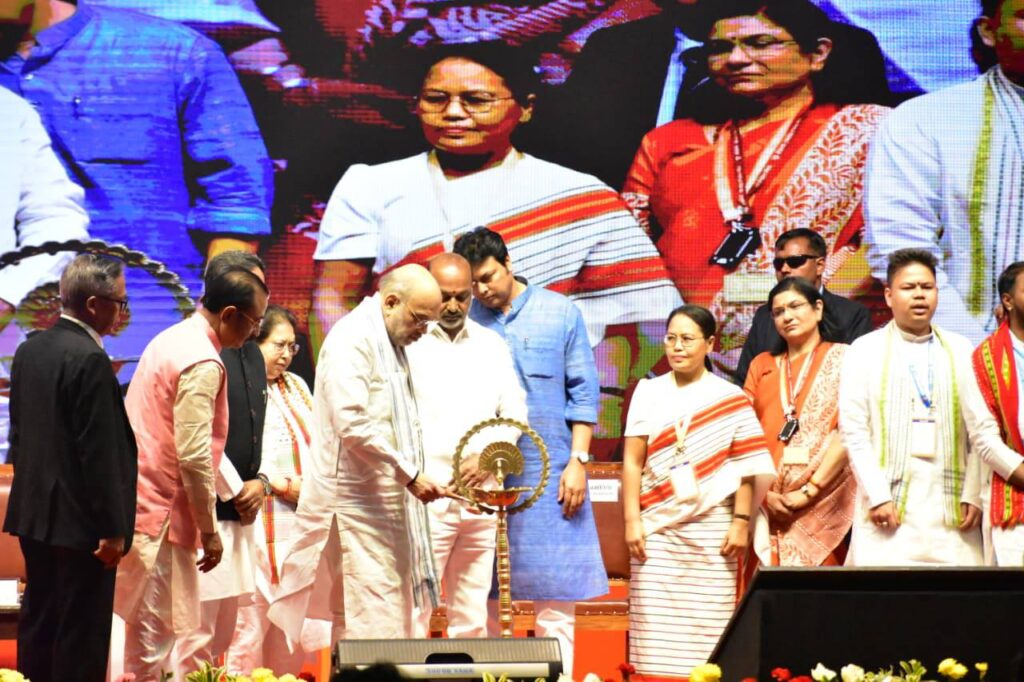
Shah framed his argument as one of linguistic self-reliance and cultural preservation. He stressed that languages were created as instruments of social cohesion and cultural progress, not conflict. Turning language and script into tools of division, he cautioned, would undermine the very purpose of their existence.
Calling for collective agreement, the Home Minister urged stakeholders to ensure that debates over script do not escalate into social discord. According to him, adopting Nagari would provide a unified direction for linguistic growth and strengthen India’s civilisational heritage.
Kokborok Script Debate Intensifies
The issue of Kokborok script has remained politically sensitive in Tripura. The ruling Bharatiya Janata Party has expressed support for Devanagari, Bengali, or even an indigenous script developed by the Kokborok-speaking community. However, its allies, including Tipra Motha and Indigenous People’s Front of Tripura, have been advocating the adoption of Roman script.
Against this backdrop, Shah appealed for consensus and emphasised that several languages and dialects of the Northeast have already embraced Nagari, leading to greater consolidation of their cultural and linguistic identity.
He pointed out that indigenous communities in the Northeast have consistently worked to protect their heritage. In that context, he questioned how such identity could be secured through a script of foreign origin.
Northeast’s Rich Linguistic Diversity
Highlighting the region’s extraordinary diversity, Shah noted that the Northeast is home to more than 200 languages and dialects, over 200 tribal communities, 50 distinct festivals, and 30 nationally recognised dance forms. This cultural richness, he said, underscores the need for unity without uniformity.
Addressing criticism regarding alleged imposition of Hindi, Shah dismissed such claims as misleading. He asserted that there is no rivalry between Hindi and regional languages. Instead, he described them as siblings nurtured within the same cultural environment.
According to Shah, Hindi does not compete with languages such as Bengali, Tamil, or Telugu, but coexists alongside them within India’s plural linguistic landscape.
Emphasis on Mother Tongue Education
A significant portion of Shah’s speech focused on education in the mother tongue. He reiterated that the Government of India has decided children will receive primary education in their mother tongue. He urged parents to ensure that children learn to read and write in their native language at home.
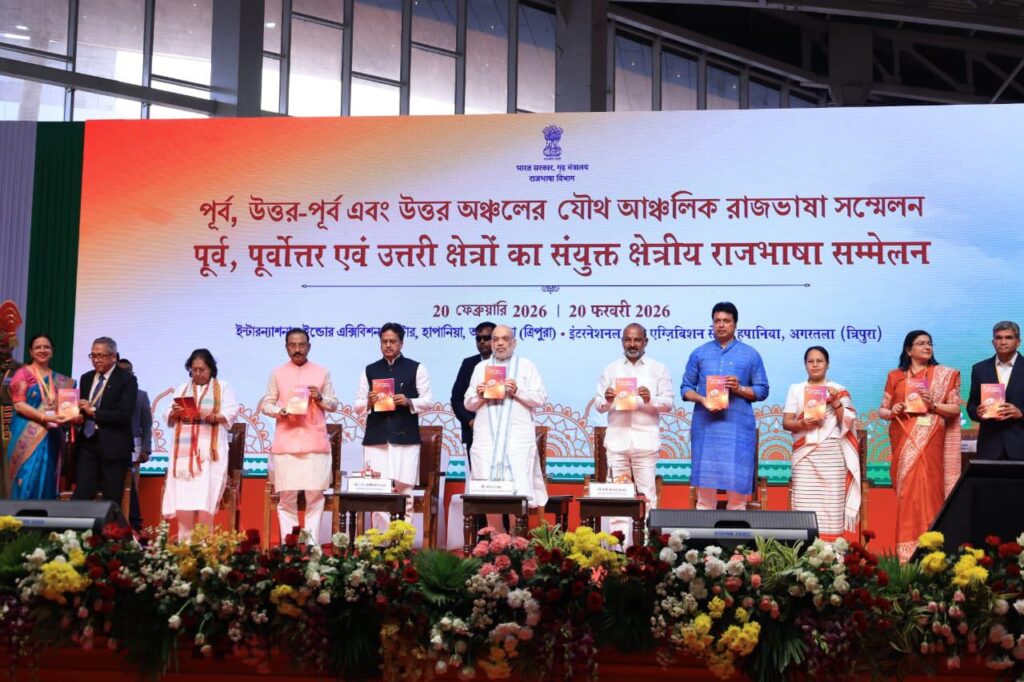
Without such grounding, he warned, younger generations risk losing access to their own literature, regional history, and cultural traditions. This, he said, could lead to a sense of disconnection from their roots in the future.
Even if students pursue formal education in other mediums, Shah insisted that proficiency in the mother tongue is essential for preserving identity and intellectual continuity.
Cultural Icons and National Integration
To reinforce his point about linguistic harmony, Shah cited cultural icons such as Bhupen Hazarika, S. D. Burman, R. D. Burman, and Zubeen Garg. He said Hindi provided them a national platform to showcase their talent while they remained rooted in their regional cultures.
He also referred to national leaders such as Mahatma Gandhi, Sardar Vallabhbhai Patel, Rabindranath Tagore, and B. R. Ambedkar, who, despite having different mother tongues, promoted Rajbhasha to strengthen national unity.
Shah further noted that under Prime Minister Narendra Modi, the Rajbhasha Department developed “Hindi Shabd Sindhu,” incorporating 84,000 words from various Indian languages to enrich Hindi and make it more inclusive.
A Clear Signal from the Centre
Shah’s strong pitch for Nagari is likely to influence the trajectory of the Kokborok script debate in Tripura. By framing the issue as one of cultural sovereignty and linguistic unity, the Home Minister has placed the emphasis on indigenous roots rather than external influences.
| Also Read: Hindi and local languages must progress together: CM |
As the debate continues, his remarks signal the Centre’s preference for scripts perceived as native to India, reinforcing a broader narrative of cultural consolidation, linguistic self-reliance, and national integration.
| Also Read: Agartala–Dhaka–Kolkata Bus Service to Resume |





