Tripura achieves 99 percent success under PM Awas Yojana, ranks top in rural governance, Union Minister Shivraj Singh Chouhan announces new housing sanctions, road connectivity projects, agriculture roadmap, and VBGRAMG reforms to boost transparency and employment.
Tripura has emerged as a national frontrunner in rural development, recording an impressive 99 percent success rate under the Pradhan Mantri Awas Yojana (PMAY), Union Minister for Agriculture and Rural Development Shivraj Singh Chouhan announced on Wednesday. He praised the state government for its effective implementation of flagship rural schemes, asserting that Tripura now holds the top position in rural governance and development performance across India.
Addressing the first-ever elected representatives’ conference organized to mark the enactment of the VBGRAMG scheme, Chouhan highlighted Tripura’s remarkable housing achievements. “Tripura had a target to construct 376,913 houses under the Pradhan Mantri Awas Yojana. So far, 373,828 houses have been completed, achieving a 99 percent success rate. No other state has come this close to its target,” he said.
The Union Minister further revealed that a fresh survey identified 255,000 unsafe dwellings across the state. After physical verification, it was determined that nearly 200,000 additional houses are required. He assured that these new houses would be sanctioned for Tripura very soon, reinforcing the Centre’s commitment to ensuring housing for all.
In addition to housing, Chouhan announced that proposals under the Pradhan Mantri Gram Sadak Yojana (PMGSY) to connect 109 villages in Tripura are in the final stages of approval. “The process is almost complete, and sanctions will be granted soon,” he stated, underlining the government’s focus on rural connectivity and infrastructure.
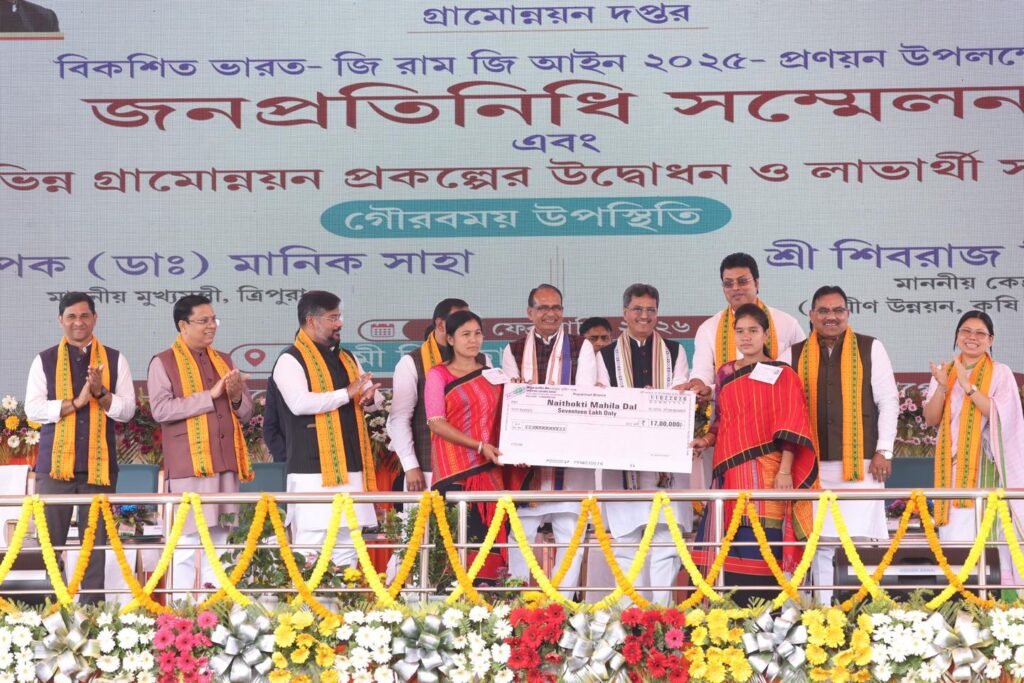
Turning to agriculture, the Union Minister said a specialized team comprising agricultural scientists, experts, and senior ministry officials would soon visit Tripura to design a comprehensive roadmap for the state’s agricultural development. He mentioned that he had discussed the matter with Chief Minister Dr. Manik Saha and decided to send experts from the Indian Council of Agricultural Research (ICAR).
The expert team will conduct soil testing, evaluate agro-climatic conditions, and assess water resources to develop a tailored strategy for boosting productivity and sustainability. “Based on their detailed report, we will chart the future course of action for Tripura’s agriculture sector,” Chouhan added.
The conference also focused on the newly enacted VBGRAMG scheme, aimed at streamlining rural employment guarantees and improving transparency. According to Chouhan, the earlier framework under MGNREGA had certain limitations that made it difficult to prevent fund mismanagement. The new rules under VBGRAMG are designed to fix accountability gaps and enhance transparency in fund utilization and project implementation.
Chief Minister Dr. Manik Saha, addressing the gathering at Swami Vivekananda Maidan in the state capital, emphasized the collective commitment toward building a developed India by 2047 under the visionary leadership of Prime Minister Narendra Modi. He congratulated elected representatives at all levels, district administrators, and officials for ensuring the success of the conference.
| Also Read: Gram Panchayats to Receive Crores Under VB–G RAM G |
Dr. Saha underscored that rural development is the cornerstone of national progress. “Without the development of villages, neither the state nor the country can progress,” he said. He described VBGRAMG as a significant milestone in strengthening rural employment and livelihood opportunities. The scheme guarantees 125 days of employment, empowers Gram Sabhas to determine work priorities based on local needs, and ensures timely wage payments—making it more effective than previous frameworks.
With record-breaking housing achievements, upcoming road connectivity projects, a focused agricultural roadmap, and enhanced employment reforms, Tripura is positioning itself as a model state in rural governance and inclusive development.