


Tripura Agriculture Minister Ratan Lal Nath urged the Centre to reform PMFBY guidelines to include local natural calamities, distribute 45,000 more soil health cards, and enhance MIDH allocations to boost horticultural expansion and protect local farmers from crop losses.
For the development of the agriculture and horticulture sectors and for the welfare of farmers, Agriculture and Farmers’ Welfare Minister Ratan Lal Nath today raised a series of demands, including the addition of “local natural calamities” to the Pradhan Mantri Fasal Bima Yojana (PMFBY) guidelines, provision of up to 45,000 soil health cards, and an increase in the allocation under the Mission for Integrated Development of Horticulture (MIDH) scheme.
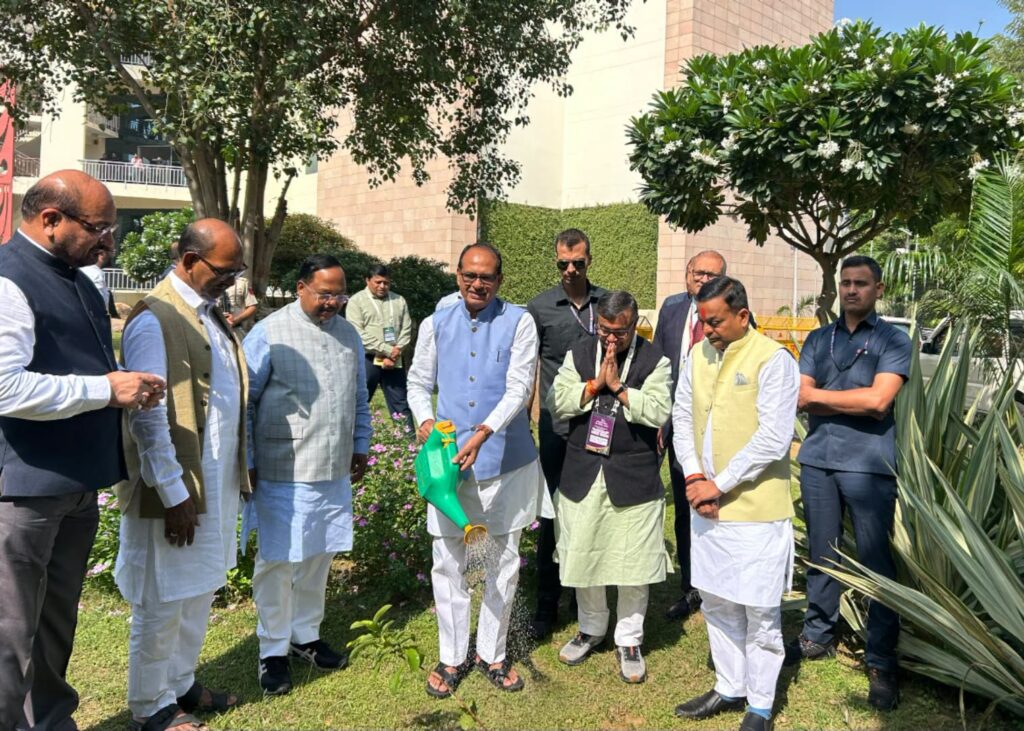
The Minister said this while addressing the second day of the National Agriculture Conference – Rabi Campaign 2026 in New Delhi.
The conference was attended by Union Minister of Agriculture, Farmers Welfare and Rural Development Shivraj Singh Chouhan, Ministers of State for Agriculture Ram Nath Thakur and Bhagirath Choudhary, Ministers of Agriculture from other States, Atish Chandra, Secretary of Agriculture, other officials from the Central Government, and officials from other States.
Nath said that this year, the Central Government has provided funds as per the State’s Action Plan and has done a great job in providing support to all the food-givers of the State.
He said that during the previous Rabi season, 25,000 hectares of hybrid paddy, 9,500 hectares of Rabi pulses and 9,700 hectares of Rabi oilseeds were cultivated, and the crops are expected to be harvested in the summer.
“This year, in the Kharif season, 37,500 hectares of area were cultivated under the Chief Minister’s Integrated Crop Management Programme, including 27,500 hectares of hybrid paddy, 2,000 hectares of aromatic rice, 15,000 hectares of pulses, 8,000 hectares of oilseeds and 1,000 hectares of summer vegetables,” said the minister.
He said, in addition, the state government is working on the Farmer’s Registry, Digital Crop Survey and National Framework for Fertilizer Sale.
The minister raised a series of issues for the betterment of farmers.
He said that in Tripura, there is a total area of 16,400 hectares under natural farming, with 38,000 farmers engaged in it.
“What I have felt in the last two years is that not only natural farming but also bio-formulation is an important input for demonstration under any scheme, and it is necessary to provide support to the Bio Input Resource Centre (BRC) for marketing, packaging and branding. In this regard, it is necessary to form a Natural Seed Grower Consortium. The MOVCD-NER scheme has been successfully implemented in Tripura. Our State has a significant amount of organic produce, which is exported to countries like Germany, Dubai and Bangladesh. Tripura has 96% small and marginal farmers, and I request that this scheme be extended to all the North-Eastern States,” he said.
Nath sought more allocation under the Sub Mission on Agricultural Mechanization (SMAM) and Per Drop More Crop (PDMC) schemes to give more attention to mechanization and irrigation in the agricultural sector.
He said that the paddy-growing areas of the State suffer greatly due to inundation of crops during heavy rains, but farmers do not get any insurance benefits. In the case of large-scale paddy crop loss, the Union Agriculture Minister is keen to include “local natural calamities” in the Pradhan Mantri Fasal Bima Yojana (PMFBY) guidelines, covering problems such as flooding and crop insurance.
The minister also demanded the provision of 45,000 more soil health cards in the State.
The minister also sought an increase in the minimum allocation for the annual action plan under the Mission for Integrated Development of Horticulture (MIDH) from 20% to 35% for the Area Expansion Programme.
He also informed that there is great potential for growing foreign fruit crops like avocado and rambutan in the State, but there is not enough quality planting material available.
| Also Read: CM to launch innovation challenge, youth scheme on Oct 1 |
“For the early expansion of the programme at the ground level, the Central Government should conduct research. The stations or recognized nurseries are also interested in making planting material available. For projects approved by the Centre of Excellence in the State, the State Government can incur an additional cost of up to 50% in addition to the MIDH scheme. Therefore, I am requesting that the MIDH grant be increased to 75% and, similarly, seeking to attract private enterprises in the Post Harvest Management Component by increasing the share from 50% to 75% from the reserve fund,” he added.





