

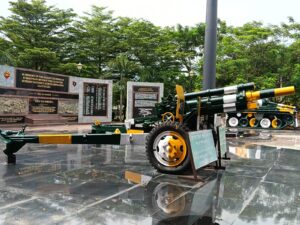
The Gun – 105-mm artillery gun -now standing silently at the Albert Ekka War Memorial in Agartala was once positioned across the border at Akhaura. In the turbulent days before the 1971 Indo-Pak war formally began, Pakistani artillery repeatedly shelled Agartala from this gun. Then, on December 2, Indian troops captured the gun. Lt Gen Sagat Singh decided that the weapon should be given to the very city it had once shelled and killed citizens.
Manas Pal
It stands silent today inside the Albert Ekka War Memorial in Agartala, an ageing artillery piece that visitors can easily walk past without knowing the extraordinary story it carries.
More than half a century ago, however, there was nothing silent about it.
The 105-mm artillery gun was captured by Indian soldiers from Pakistani forces at Akhaura across Agartala during the opening phase of the Bangladesh Liberation War. Evidence from the military history of the campaign indicates that it was seized by troops of 10 Bihar on December 2, 1971—a day before India and Pakistan formally went to war.
And it has a remarkable journey from the battlefield to Agartala.
The gun was apparently among the Pakistani artillery weapons that had been firing towards Agartala from positions across the border. After its capture, Lt Gen Sagat Singh, the legendary commander of the Indian Army’s IV Corps, made a point of presenting the captured weapon to the people of the very town that had endured the shelling from its barrel.
Thus a gun that had once threatened Agartala returned to the city not as a weapon of war, but as a trophy of war.
For decades after 1972, it stood at Post Office Chowmuhani, one of the busiest intersections in the heart of Agartala. Generations grew up seeing it there, along with a PT-76 amphibious tank displayed nearby. Painted and repainted over the years, the two became familiar city landmarks. In 2020, they were shifted to the newly developed war memorial complex named after Param Vir Chakra recipient Lance Naik Albert Ekka, who was killed in action during the 1971 campaign.
Most people in Agartala knew they were trophies associated with the 1971 war and the liberation of Bangladesh. What was, however, largely forgotten was the story of how they reached Agartala.
The artillery gun’s story begins just across the present India-Bangladesh border at Akhaura, one of Pakistan’s strongest defensive positions facing Tripura in 1971.
Pakistan’s 27 Infantry Brigade, commanded by Brigadier Saadullah Khan, was responsible for the sector, while 12 Frontier Force held the Akhaura-Gangasagar defences. Facing them was India’s 57 Mountain Division, operating under Lt Gen Sagat Singh’s IV Corps, who was then stationed in Agartala.
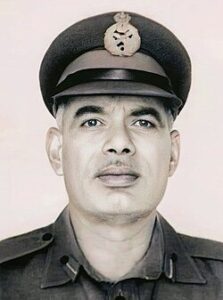 Lt Gen Sagat Singh
The geography placed the Tripura capital in an extraordinarily vulnerable position.
Akhaura was only a few kilometres away. Even before the formal outbreak of the Indo-Pak war on December 3, Pakistani artillery had been firing intermittently—and sometimes for prolonged periods—towards Agartala from November 1971. The shelling was no distant battlefield phenomenon for the people of the town. Shells landed in different parts of Agartala and civilians here were killed.
Maj Gen Randhir Sinh, in his military biography of Lt Gen Sagat Singh, A Talent for War, records Pakistani artillery shelling Agartala during the fighting. On one occasion, shells even landed in the grounds of Raj Bhavan, where Sagat Singh was staying. Then the direction of the battle changed.
|Also Read : Lt Gen Sagat Singh, A Talent for War https://songramernotebook.com/archives/90049 As Indian forces began operations against the formidable Akhaura defences, 311 Mountain Brigade of 57 Mountain Division committed 10 Bihar to infiltrate and secure the area north of Gangasagar.
On December 2, 1971, while expanding the territory it had captured, troops of 10 Bihar overran a Pakistani position and seized a 105-mm artillery gun. The officer associated with its capture was Major D. P. Singh, a company commander of 10 Bihar, whose commanding officer was Lt Col P. C. Sawhney. The timing is significant. The weapon was captured one day before the Indo-Pak war formally began on December 3, although Indian and Pakistani troops were already engaged in intense fighting around Akhaura.
It may be mentioned here that it was also on December 3-4 night 1971, the night War was declared officially 14 Guards regiment crossed over to East Pakistan and in a fierce battle cleared the Gangasagar rail station of the Pakistanis. It was in this battle Ln Naik Ekka showed unbelievable valour and raw courage before his supreme sacrifice. There were 10 others who were also martyred in the battle. Their mortal remains were brought to Agartala and they were laid to rest at Dukli in the city outskirt. Ln Nk Ekka became the only Paramveer in the Eastern sector and it was after his name the War memorial park in the city was established. It is in this park the artillery gun we are talking about is now placed.
Three days later on December 5, Sagat Singh flew over the Akhaura battlefield and noticed Pakistani troops withdrawing. He landed behind the advancing Indian troops and, according to Randhir Sinh’s account, encountered Major D. P. Singh—the company commander who had captured the 105-mm gun—and ordered him to press the advance.
Akhaura fell. The Pakistani defensive position immediately opposite Agartala had been broken, and the route towards Brahmanbaria was opening before the Indian Army.
But Sagat Singh apparently had not forgotten the artillery fire that Agartala had endured. Randhir Sinh’s biography records that the IV Corps commander made it a point to give the captured Pakistani 105-mm gun to the people of Agartala, precisely because Pakistani artillery had caused the town so much harassment. It was, indeed, an unusually symbolic gesture.
A weapon positioned across the border had fired towards an Indian town. Indian soldiers crossed the frontier, fought through the Pakistani defences and captured it. Their corps commander then sent the gun back to the town at which it had once been aimed. And there it has remained for more than five decades.
Today, visitors to the Albert Ekka War Memorial see an old artillery gun. What they are actually looking at is a piece of the battlefield of Akhaura—and a silent witness to the days when the Bangladesh Liberation War was being fought virtually at Agartala’s doorstep.
It was after Lt Gen Sagat Singh a road in Red Shield army area in city has been named.
|Also Read : The Tank that changed sides and then came home
https://tripuranet.com/the-tank-that-changed-sides-54422.html |
Principal sources of the two articles published :
The most important source for the gun and Sagat Singh connection is Maj Gen Randhir Sinh’s A Talent for War: The Military Biography of Lt Gen Sagat Singh, particularly its account of the Battle of Akhaura, Major D. P. Singh and the captured 105-mm gun.
The Government of India’s official history of the 1971 war, chapter on 57 Mountain Division operations, provides the strongest official confirmation of the capture of Akhaura on December 5, the two PT-76s recorded as captured, and the subsequent advance to Brahmanbaria and Ashuganj.
For the extraordinary 1965 connection, the specialist article in the US Army’s ARMOR records that Pakistan’s 27 Infantry Brigade PT-76 troop was raised from four tanks captured from India in 1965 and separately recounts the history of the 7th Light Cavalry PT-76 recovered again in 1971.
The surviving 1966 photograph and catalogue record of the captured Indian PT-76 from Bedian ( Pakistan Punjab) being brought into Comilla provides particularly valuable visual evidence that captured Indian PT-76s were transported to East Pakistan after the 1965 war.





