


Union Minister Shivraj Singh Chouhan announced Rs 10 lakh crore investment in rural India under VB–G RAM G over the next decade, guaranteeing 125 days of employment, higher allocations to Gram Panchayats, and stronger financial safeguards for workers.
Union Minister for Agriculture, Farmers’ Welfare and Rural Development Shivraj Singh Chouhan on Wednesday announced that the Central Government will spend Rs 10 lakh crore in rural India over the next ten years under the Viksit Bharat–Guarantee for Rozgar and Ajeevika Mission (Gramin), widely referred to as VB–G RAM G.
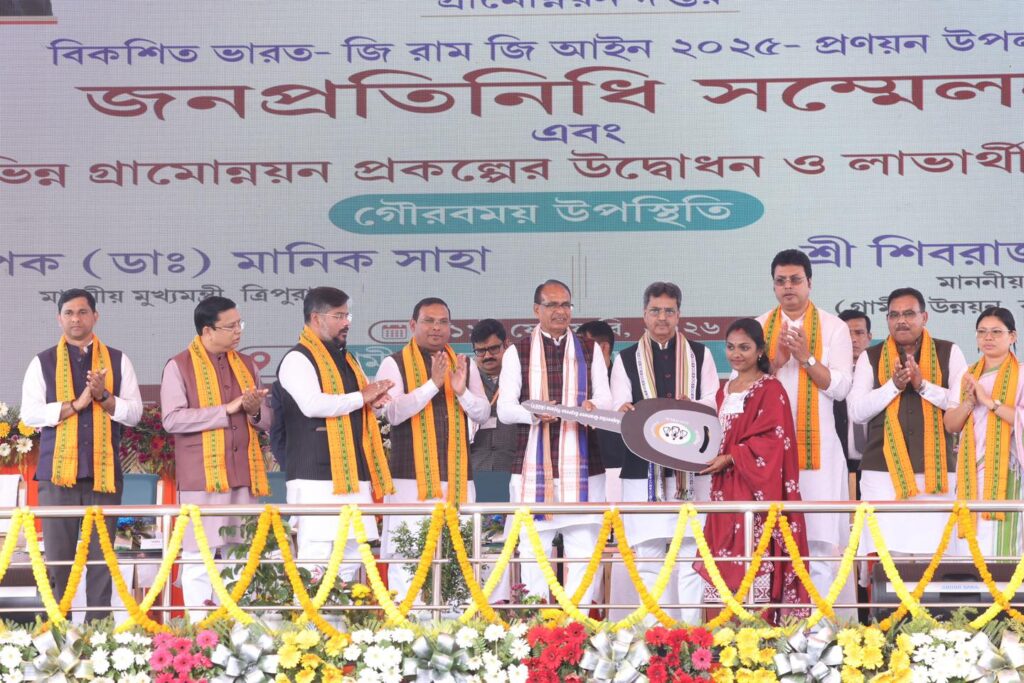
Addressing a conference on the ambitious rural employment and livelihood programme in Tripura’s capital Agartala, Chouhan described the initiative as a comprehensive roadmap aimed at building a developed India while ensuring inclusive growth across villages. He emphasized that the scheme has been designed to safeguard the interests of all sections of society, particularly marginalized communities and economically weaker groups.
125 Days of Guaranteed Employment
Highlighting the key features of the programme, the Union Minister said that VB–G RAM G guarantees 125 days of employment annually to rural households, marking a significant increase from the earlier 100-day provision under previous rural job schemes. According to Chouhan, this expansion reflects the government’s commitment to strengthening livelihood security in villages and reducing rural distress.
He stated that Rs 1,51,282 crore has been earmarked for the rural programme, with an additional Rs 55,000 crore expected through the Finance Commission. This would take the total allocation to over Rs 2 lakh crore over a five-year period. Chouhan further clarified that over the next decade, cumulative spending under the scheme would reach Rs 10 lakh crore, ensuring sustained investment in rural infrastructure, job creation, and income generation.
Direct Benefits to Gram Panchayats
The Minister said the scheme would directly empower local self-government institutions. According to him, there are approximately 2.86 crore Gram Panchayats across the country, and each Panchayat would receive between Rs 1.50 crore and Rs 2.75 crore over five years under the programme. These funds are expected to be utilized for rural development works, asset creation, and community infrastructure.
He asserted that strengthening Panchayats financially would enable grassroots-level planning and execution of development projects tailored to local needs. By increasing administrative expenditure from six per cent to nine per cent, the government aims to ensure smooth implementation without salary-related disruptions for Panchayat secretaries, employment assistants, clerical workers, and technical staff.
Stronger Worker Safeguards
Chouhan underscored that the VB–G RAM G programme includes enhanced safeguards for rural workers. If employment is not provided after a worker formally demands work, the scheme mandates payment of unemployment allowance. Additionally, in cases of delay in wage payments, beneficiaries will receive their dues along with applicable interest.
“These provisions demonstrate our commitment to transparency and accountability,” he said, adding that timely payments and guaranteed compensation mechanisms would boost confidence among rural laborers.
Comparison with Previous Governments
Drawing a comparison with earlier administrations, Chouhan said that during the ten years of the UPA government, Rs 2.13 lakh crore was spent on rural job works. In contrast, he claimed that the NDA government has spent Rs 8.54 lakh crore over the last ten years on similar rural employment initiatives. The new allocation under VB–G RAM G, he said, represents a further scale-up in both ambition and financial commitment.
Focus on Housing and Social Justice
The Union Minister also addressed broader rural development efforts, including housing initiatives. Referring to the Pradhan Mantri Awas Yojana (PMAY), he said the government is ensuring that no poor family remains in a temporary dwelling, with permanent houses being constructed across villages.
Chouhan alleged that rural Tripura did not witness significant development during previous Left and Congress regimes. He maintained that the current government is committed to accelerating progress, especially in remote and tribal-dominated regions.
Responding to criticism of the VB–G RAM G scheme, the Minister claimed that a misinformation campaign was being carried out against the programme. He asserted that tribal communities, Scheduled Castes, and other disadvantaged groups would be among the primary beneficiaries of the initiative.
Vision of a Developed Rural India
Describing VB–G RAM G as a cornerstone of the Viksit Bharat vision, Chouhan said the mission goes beyond employment generation and aims to transform rural India into a self-reliant and economically vibrant sector. By combining employment guarantees, financial allocations to Panchayats, social security provisions, and infrastructure development, the government hopes to create sustainable livelihood opportunities for millions.
| Also Read: Union Minister to launch landmark elected representatives conference |
As the programme rolls out nationwide, the Union Government projects it as one of the largest rural investment drives in India’s history, with the potential to reshape the socio-economic landscape of villages over the coming decade.





