
Indian Army creates history on Republic Day 2026 by showcasing a unique animal contingent featuring camels, ponies, raptors and Army dogs, highlighting innovation, self-reliance and the vital role of animals in national defence.
India’s 77th Republic Day celebrations in 2026 witnessed a historic and visually striking moment as the Indian Army presented a specially curated animal contingent during the ceremonial parade along Kartavya Path. For the first time in the history of the Republic Day parade, a diverse formation of animals from the Indian Army’s Remount and Veterinary Corps (RVC) marched in unison, drawing national attention to a lesser-known yet critical pillar of India’s defence preparedness.
The inclusion of this animal contingent marked a symbolic and operational milestone, highlighting the indispensable role animals continue to play in safeguarding some of the country’s most inhospitable and strategically sensitive regions. The formation represented a unique convergence of tradition, innovation and self-reliance, reinforcing the Army’s ability to adapt to extreme environments through unconventional yet highly effective means.
The contingent comprised two Bactrian camels, four Zanskar ponies, four trained raptors, ten Indian-breed Army dogs and six conventional military dogs currently in active service. Together, they reflected the Indian Army’s multi-dimensional operational ecosystem that blends modern warfare techniques with time-tested natural strengths.
Leading the formation were the newly inducted Bactrian camels, specifically chosen for deployment in the cold deserts of eastern Ladakh. Unlike their single-humped counterparts, Bactrian camels are biologically adapted to survive in extreme cold, low oxygen levels and high-altitude terrain exceeding 15,000 feet. Capable of carrying loads of up to 250 kilograms, these camels can traverse long distances with minimal water and feed, making them invaluable assets for logistics and mounted patrols along the Line of Actual Control. Their induction has significantly enhanced the Army’s operational flexibility in sandy terrain, frozen passes and steep gradients where mechanised transport often faces limitations.
Marching alongside the camels were the resilient Zanskar ponies, an indigenous mountain breed native to the Ladakh region. Despite their compact build, these ponies are renowned for their exceptional stamina and adaptability. They routinely carry loads ranging between 40 and 60 kilograms across treacherous terrain at altitudes exceeding 15,000 feet, even in temperatures that can plummet to minus 40 degrees Celsius. Since their induction in 2020, Zanskar ponies have been deployed in some of India’s most hostile operational zones, including the Siachen Glacier. Beyond logistics, they play a vital role in mounted patrols, often covering distances of up to 70 kilometres in a single day.
Adding a modern operational dimension to the formation were four trained raptors, deployed by the Indian Army primarily for bird-strike prevention and aerial surveillance. Their presence underscored the Army’s innovative use of natural predatory instincts to enhance safety and situational awareness in sensitive areas such as airfields and forward installations.
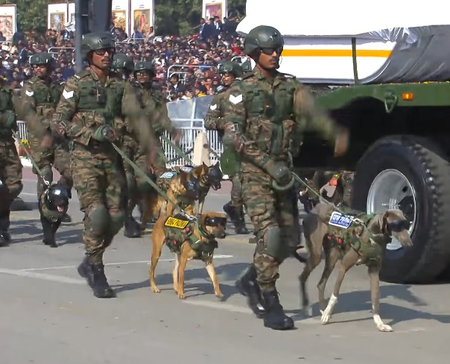
A major highlight of the parade was the presence of Army dogs, often referred to as the “Silent Warriors” of the Indian Army. These dogs are bred, trained and medically supported by the Remount and Veterinary Corps at the RVC Centre and College in Meerut. They play a critical role in counter-terrorism operations, mine and explosive detection, tracking insurgents, guarding vital installations, disaster response and search-and-rescue missions. Over the years, Army dogs and their handlers have demonstrated extraordinary bravery, earning gallantry awards and commendations for both combat and humanitarian operations.
In line with the Atmanirbhar Bharat vision and the Make in India initiative, the Indian Army has increasingly focused on inducting indigenous dog breeds such as Mudhol Hound, Rampur Hound, Chippiparai, Kombai and Rajapalayam. Their participation in the Republic Day parade highlighted India’s growing self-reliance in defence capabilities and the successful integration of native breeds into specialised military roles.
| Also Read: Assam CM warns of demographic threat to indigenous identity |
As the animal contingent marched past the saluting dais on Republic Day 2026, it served as a powerful reminder that India’s defence strength extends beyond advanced weapons and modern machinery. From the icy heights of Siachen and the cold deserts of Ladakh to disaster-stricken civilian areas, these animals have consistently shared the burden of duty, courage and sacrifice.
They marched not merely as ceremonial participants, but as warriors on four legs, embodying resilience, loyalty and the Indian Army’s unwavering commitment to protect the nation under all conditions.