


Tripura Rural Livelihood Mission (TRLM) and IIT Roorkee sign a three-year MoU to strengthen women-led handloom enterprises, supporting 500 SHG weavers across North Tripura, Unakoti and Dhalai through technology, design, entrepreneurship, branding, digital literacy and modern market access.
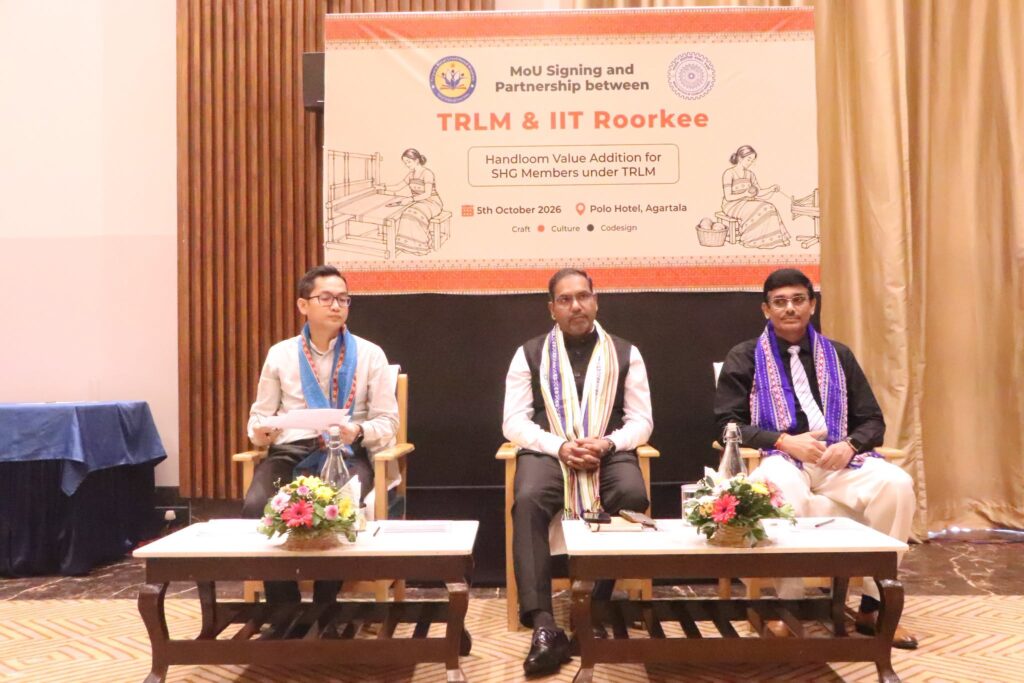
The Tripura Rural Livelihood Mission (TRLM) and the Indian Institute of Technology (IIT) Roorkee have entered into a three-year strategic partnership aimed at strengthening women-led handloom enterprises and transforming traditional weaving into a viable, sustainable and scalable livelihood opportunity in Tripura.
The Memorandum of Understanding (MoU) was signed in the presence of Abhishek Singh, Secretary, Rural Development Department, Government of Tripura. TRLM CEO Tarit Kanti Chakma and Dr. Bibhuti Ranjan Bhattacharjya, Assistant Professor, Department of Design, IIT Roorkee, signed the agreement on behalf of the two institutions.
The partnership seeks to combine traditional handloom skills with technology, design, research, entrepreneurship and modern business practices. The initiative is expected to provide women weavers associated with Self-Help Groups (SHGs) with better opportunities to improve productivity, product quality, market access and enterprise management.
The collaboration will cover around 500 SHG women weavers across North Tripura, Unakoti and Dhalai districts. These districts have a significant presence of rural communities involved in traditional livelihood activities, and the initiative is expected to provide institutional support to help handloom-based enterprises become more competitive and sustainable.
The partnership will focus on five major areas. The first is technological intervention, under which improved looms, tools and process automation will be explored to enhance weaving efficiency and production processes. The adoption of appropriate technology is expected to help weavers improve productivity while retaining the traditional character of their products.
The second focus area is knowledge transfer, covering design development, quality standards, product diversification and sustainable production practices. Through institutional expertise, women weavers will have opportunities to gain knowledge about changing consumer preferences and develop products suited to contemporary markets.
The third pillar is branding and packaging. The initiative aims to support the development of distinctive brand identities for handloom products and improve packaging so that products become more attractive and market-ready. Stronger branding is expected to help local handloom products gain visibility beyond traditional markets.
The partnership will also emphasise entrepreneurship development through capacity building for enterprise creation and management. Women members of SHGs will be encouraged to strengthen their understanding of business planning, enterprise operations and financial and managerial practices, helping them move towards more organised and sustainable handloom enterprises.
The fifth area is modern business orientation, with emphasis on digital literacy, e-commerce and access to contemporary markets. By improving digital capabilities and understanding of online marketplaces, weavers can potentially reach customers beyond their immediate geographical areas and explore new channels for selling their products.
The three-year collaboration represents an effort to bridge traditional craftsmanship with modern enterprise practices. By bringing together TRLM’s rural livelihood network and IIT Roorkee’s technical and design expertise, the initiative is expected to create a stronger support system for women-led handloom enterprises.
| Also Read: GB Pant doctors resume duties after assurances over alleged false video |
The partnership is also aimed at strengthening the wider handloom value chain in Tripura by addressing areas such as production, design, branding, entrepreneurship and marketing. The initiative seeks to make traditional weaving more viable as a livelihood while creating opportunities for women SHG members to participate more actively in enterprise development.
The collaboration highlights the growing importance of combining traditional skills with technology and market-oriented approaches. For Tripura’s women weavers, the partnership is expected to open new avenues for innovation, enterprise development and market access while supporting the continued growth of the state’s handloom sector.





