Tripura CM Dr. Manik Saha reviewed major revenue reforms, including automatic land mutation, NAKSHA, BHUNAKSHA, tea estate management, and Agri-Stack initiatives, directing time-bound implementation to ensure transparent governance, ease of doing business, faster public services, and citizen-friendly land administration across the state.
Tripura Chief Minister Dr. Manik Saha on Monday chaired a high-level review meeting to assess the progress of a series of proposed revenue reforms aimed at modernising land administration, strengthening transparency, improving public service delivery, and enhancing the ease of doing business across the state.
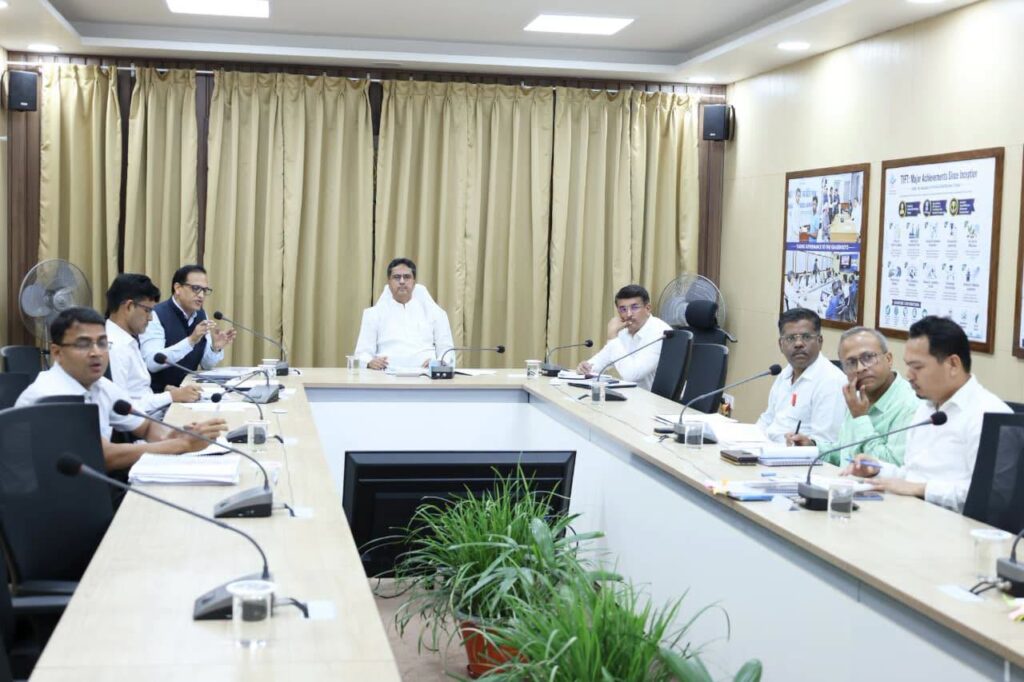
The meeting, held at the Conference Hall of the Tripura Institute for Transformation (TIFT), focused on several key initiatives, including automatic land mutation, digital land surveys under the BHUNAKSHA project, ground truthing of the NAKSHA project in Agartala, tea estate management reforms, rationalisation of circle rates, forest patta demarcation, and the implementation of the Agri-Stack digital platform.
Sharing details after the meeting, Chief Minister Dr. Saha said the proposed reforms were designed to establish a people-friendly revenue administration while ensuring greater transparency, accountability, and efficiency in government services. He directed the Revenue Department to ensure that all reforms are implemented on the ground within a fixed timeline to avoid delays in service delivery and improve governance.
One of the major proposals reviewed during the meeting was the introduction of an Automatic Land Mutation system. The proposed digital mechanism will automatically update land records following the registration of land transactions, significantly reducing manual intervention and eliminating the need for repeated visits to government offices. The Chief Minister observed that the initiative would make land mutation seamless, transparent, time-bound, and hassle-free while improving the accuracy and reliability of land records. He also instructed officials to study successful automatic mutation models implemented in other states before introducing the system in Tripura.
The meeting also reviewed reforms concerning the tea sector. Discussions centred on promoting tea tourism, encouraging productive utilisation of vacant tea estate land, reducing unnecessary litigation, and creating a favourable environment for private investment. According to officials, these measures are expected to generate employment opportunities, strengthen the state’s tea industry, and contribute to economic growth while safeguarding the interests of tea workers and other stakeholders.
Significant attention was given to the NAKSHA (National Geospatial Knowledge-based Land Survey of Urban Habitation) Project. The initiative aims to develop accurate digital land records using modern geospatial technologies and high-resolution mapping for better urban land management. Officials informed the meeting that the ground truthing exercise under the project is expected to commence soon within the Agartala Municipal Corporation area.
The Chief Minister also reviewed the implementation of the Agri-Stack programme, a flagship Digital Public Infrastructure initiative jointly executed by the Revenue and Agriculture Departments. The project seeks to establish a verified Farmer Registry, geo-referenced farm maps, and crop sown registers to improve agricultural planning, facilitate transparent delivery of government benefits, and strengthen the implementation of welfare schemes for farmers.
During the meeting, Dr. Saha highlighted that the existing Tripura Land Revenue and Land Reforms (TLR & LR) Act, 1960, does not currently provide provisions for the mutation of flats and apartments. He instructed the Revenue Department to place a proposal before the State Cabinet for suitable legal amendments to enable individual mutation of apartment ownership.
The Chief Minister further directed officials to expedite the digital demarcation of nearly five lakh pending land plots under the BHUNAKSHA project using modern survey equipment. He also instructed the department to initiate the demarcation of approximately 1.31 lakh forest patta plots in a phased and time-bound manner to ensure accurate land records and improve land governance.
Emphasising technology-driven governance, Dr. Saha directed all concerned departments to maintain close inter-departmental coordination, adopt digital technologies extensively, and continuously monitor the implementation of each reform initiative. He said the reforms would not only strengthen transparency and accountability in the revenue administration but also improve public service delivery, attract investment, enhance agricultural productivity, and create a more business-friendly environment in Tripura.
| Also Read: CPI(M) Meets Governor Over DGP Death Investigation |
The Chief Minister reiterated that efficient land administration is essential for accelerating economic development and ensuring better governance. He expressed confidence that the proposed reforms would build a modern, transparent, digitally empowered, and citizen-centric revenue administration capable of meeting the growing needs of the people while supporting sustainable development across the state.
The review meeting was attended by Chief Minister’s Secretary Kiran Gitte, Revenue Department Secretary Milind Ramteke, Additional Secretary Subhash Chandra Saha, and other senior officials. District Magistrates and Collectors of all eight districts participated in the meeting through video conferencing.