The Clash of Civilizations: The Red–Green alliance and the question, is Huntington’s prophecy coming true in Europe?
Manas Pal
My moot point in this article is -the Red–Green alliance and the uncomfortable contradictions.
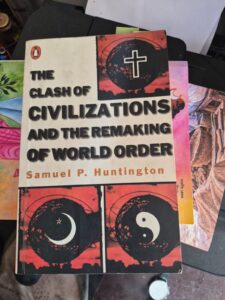
Many years ago when I first read Samuel P. Huntington’s The Clash of Civilizations and the Remaking of World Order , I had faint idea as to what he was driving at. The language of the book was not that difficult but the moot point was deep and difficult in a sense. It needed some practical spectacle to understand, properly. I did not seriously think about them then. But now as the violence and clashes are unfolding before me in France or Italy in the name of student unrest – and to some extent in India and Bangladesh, -that spiral/ spiralled into fullscale violence with political and criminal elements getting involved -I find nearly three decades after the publication of his celebrated book, Europe appears increasingly preoccupied with precisely the questions Huntington raised. Not so much about territorial conquest or military confrontation, but about something far more complicated: the survival, transformation and possible dilution of civilizational identity.
Look at France. The country that gave the world the Enlightenment, the revolutionary ideals of liberty, equality and fraternity, and the uncompromising principle of laicite , or secularism, now finds itself engaged in an increasingly violent confrontations and faces bloody assaults over immigration, Islam, religious expression and the very meaning of being French.
The controversy is not merely about the hijab, mosques or religious symbols in public institutions. Beneath these visible disputes lies a much larger and more uncomfortable question: Can a secular republic accommodate expanding religious and cultural identities without compromising the principles upon which that republic was founded?
Till the present-day violence erupts, France insists that citizenship must transcend religion. Yet sections of its Muslim population argue that the republic’s interpretation of secularism sometimes makes the public expression of their faith unnecessarily difficult. Meanwhile, nationalist political forces contend that excessive accommodation of distinct religious identities threatens the country’s cultural cohesion.
The result is a peculiar contradiction. A republic founded upon the emancipation of the individual increasingly finds itself debating how much cultural individuality it can accommodate.
But there is another contradiction, perhaps, even more remarkable, which deserves closer scrutiny.
It concerns the European Left. The Left is supposed to ‘regard organised religion with suspicion, defend secularism, champion women’s emancipation and challenge religious orthodoxy’. Yet sections of that same political tradition now find themselves making common cause, at least on selected political issues, with religiously conservative and rabidly anti- democracy movements whose social philosophies are often fundamentally incompatible with the progressive ideals the Left professes to uphold. This curious political convergence has acquired a controversial description: the Red–Green alliance. Red represents the socialist, communist and radical-left traditions. Green, in this particular formulation, refers not to environmental politics but to political Islam. The expression is used by critics to describe a convergence between sections of the radical Left and Islamist political currents, often around shared opposition to Western interventionism, Israel, perceived Islamophobia and established political institutions.
It is not a formal European-wide alliance, nor does it encompass the entire Left or Muslim communities generally. Nevertheless, dismissing the phenomenon altogether would be as intellectually naive and in course of time seriously counter productive.
France offers a particularly revealing example.
As I read about the France’s political standings I found France’s Left leader Jean-Luc Melenchon’s La France Insoumise, or France Unbowed, has increasingly emphasised anti-racism, Muslim minority concerns and the Palestinian cause. These positions are not inherently Islamist. But the problem is the Left has chosen a wrong partner, a rabid and extremely dangerous Islamic outfit, Hamas. The Hamas involvement in violence of France is well established by the international observers and also the French authorities. (When you look at the France’s raging violence that is sweeping the cities and destroying and looting – carry the Palestinian flag (not the French flag).
Now there is an important point.
It begins when political solidarity with a religious minority risks becoming political indulgence towards religious fundamentalism, when criticism of Islamist ideology is too readily confused with hostility towards Muslims, and when the defence of minority rights appears, in particular circumstances, to overshadow the defence of secular republican values. And what happens when the desire to defeat the political Right becomes so overriding that ideological inconsistencies are treated as inconveniences rather than questions of principle? A principle that changes its meaning according to the political usefulness of the person invoking it is no longer much of a principle. It is an instrument of convenience.
These are not merely accusations emanating from the French far Right. They are there and need a closer understanding.
It begins when political solidarity with a religious minority risks becoming political indulgence towards religious fundamentalism; when criticism of Islamist ideology is too readily confused with hostility towards Muslims, and when the defence of minority rights appears, in particular circumstances, to overshadow the defence of secular republican values.
And, … France is boiling . Macron ignored the warning of the French parliamentary commission of inquiry report that In December 2025, examined links between political representatives and networks promoting Islamist ideology. Its findings identified troubling proximities involving certain La France Insoumise elected representatives and individuals associated with Islamist currents.
The report provided grounds for questioning the political judgement of certain French elected representatives and the electoral calculations that might lie behind such associations. But it was ignored.
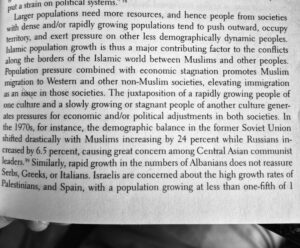
Now, if we look at the situation what Huntington said : He was prophetically clear. In his celebrated book The Clash of Civilizations and the remaking world order, Huntington writes : Larger populations (here Islamic) need more resources, and hence people from societies with dense and/or rapidly growing populations tend to push outward, occupy territory, and exert pressure on other less demographically dynamic peoples. Islamic population growth is thus a major contributing factor to the conflicts along the borders of the Islamic world between Muslims and other peoples. Population pressure combined with economic stagnation promotes Muslim migration to Western and other non-Muslim societies, elevating immigration as an issue in those societies. The juxtaposition of a rapidly growing people of one culture and a slowly growing or stagnant people of another culture gener-ates pressures for economic and/or political adjustments in both societies…” ( p 119)
Coming back to home the recent CJP movements seemed to have accommodated and given leadership to ultra-Leftists with hugely soft corner for the Islamic fundamentalists. Example Neha Bora. She- an AISA leader which is affiliated with CPI(ML) Liberation ( Naxals) is an openly available product of the inherently growing Left radical- Islamic fundamentalist alliance.
She during a speech at JNU on October 15, 2026, openly praised Umar Khalid, who has been detained under the Unlawful Activities (Prevention) Act (UAPA) in connection with the 2020 Delhi riots conspiracy case. She referred to Khalid as an “activism teacher” and stated that students learn activism by looking at him.
If this was not enough, she also praised and admitted of having been inspired by the Bangladesh 2024 July uprising which was instigated by Deep State and then hijacked by the Islamic radicals. The present-day Bangladesh situation – especially anti-Hindu ( Kufr) violence, increasingly economic downfall of Bangladesh can give an obvious example as to how and where such violent uprising could lead.

In West Bengal we saw how the CPI(M) had also allied with Furfura Sharif for political gain.
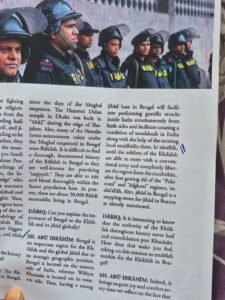
As for Bangladesh the Islamic Jihad spearheads like ISIS had already made their position clear. It is Tawahhush or total chaos through which the ISIS felt its idea of Wilyat khurasan will b e achieved.( ISIS mouthpiece Dabiq Issue 14) (Wilayat is an Arabic word for an administrative province or governorate governed by a wali –governor. Khorasan refers to a historical region encompassing parts of modern-day Afghanistan, Pakistan, Iran, and Central Asi). ( Dabiq Interview with Shyakh Abu Ibrahim al Hanif, Amir of Khalifa’s Soldiers in ‘Bengal’)
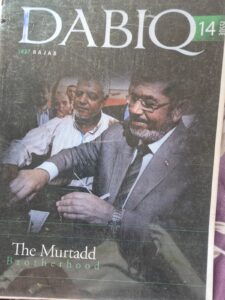
While the Twahhush or total chaos that Bangladesh witnessed overthrowing Shekh Hasina was not exactly an ISIS making but eventually it was fomented and guided by the ISIS inspired Madrasa educated mobs where later even the educated youths took part. The character of such Twahahush can very well be understood by the fact that even a young Dr. Orakatul Jannat, a dental surgeon and a prominent oncologist of Bangladesh had taken part in the mob looting of Ganavaban.
And this is precisely where Huntington’s warning assumes an altogether different and perhaps more frightening dimension.
The clash of civilizations may not necessarily begin with armies marching across borders, or one religious community declaring war upon another. It may begin much more quietly, within the political and intellectual institutions of a society, when ideological convictions are sacrificed at the altar of political expediency.
The irony is almost breathtaking.
The Left, which once considered religion the opium of the masses, now finds sections of its own political fraternity accused of embracing religious fundamentalists in the name of fighting fascism. The champions of secularism appear, on occasion, remarkably reluctant to confront religious orthodoxy when it comes dressed in the politically convenient attire of minority rights. And those who once demanded freedom from religious authority now risk becoming apologists for precisely the kind of authority they historically opposed.
The real question is disturbingly simple:
If the Left is prepared to compromise its secular, democratic and emancipatory principles to defeat the Right, what exactly will remain of those principles after the Right has been defeated?
And what if the religious fundamentalists it considers temporary political fellow travellers have no intention of reciprocating that ideological generosity?
History has repeatedly demonstrated that political alliances forged around a common enemy do not necessarily survive the disappearance of that enemy. Sometimes the allies themselves become the next adversaries.
Huntington warned of the fault lines between civilizations. What he perhaps did not sufficiently anticipate was the possibility that those fault lines could be widened by political forces operating from within the civilizations themselves.
The Red–Green alliance, wherever such a convergence can actually be demonstrated, therefore deserves scrutiny not merely as an electoral arrangement but as a profound ideological contradiction. Its danger lies not in the colour of the flags carried at demonstrations, but in the possibility that the defence of liberty may become an excuse for accommodating those who reject liberty itself.
And perhaps the ultimate tragedy will not be that one civilization has conquered another.
It will be that a civilization, in its eagerness to appear tolerant, becomes uncertain about the very principles it is supposed to tolerate no compromise on.
The emperor, this time, has not merely forgotten his clothes. His ideological tailors are busy explaining why nakedness is the latest expression of progressive enlightenment.
Huntington may not have been a prophet. But if his prophecy ever comes true, history may record that the clash was not simply imposed upon Europe from outside. Perhaps, Europe’s own political contradictions helped prepare the battlefield.
Also Read : https://tripuranet.com/indian-diaspora-rallies-in-london.html
Also Read : Multiple French cities announce curfew after violent weekend protests: report