Karimganj youth plots suicide attack on IAF station in Gujarat, arrested
In a disturbing development with potentially serious security implications for the Northeast, a 22-year-old youth from Ratacherra in Assam’s Karimganj –Mohammad Saharul Islam Kabiruddin-district has been arrested by the Gujarat Anti-Terrorism Squad (ATS) for allegedly conspiring with Pakistan-based terror outfit Jaish-e-Mohammed (JeM) to carry out an armed attack on a vital Indian Air Force installation thousands of kilometres away in Vadodara.

The arrest has brought into focus a disturbing possibility: the reach of Pakistan-based terror networks may extend beyond their traditional areas of operation, with young men from geographically distant regions allegedly being recruited, radicalised and assigned missions in other parts of the country. The alleged involvement of a youth from the Karimganj area in a planned attack in Gujarat marks a particularly ominous development that warrants close scrutiny by security and intelligence agencies in Assam and the Northeast.
What makes the case especially alarming is that the accused was allegedly not merely in contact with a terrorist organisation but had travelled across several states, procured an automatic assault rifle through a covert weapons delivery arrangement and conducted reconnaissance of a strategically important military installation.
The accused has been identified as Mohammad Saharul Islam Kabiruddin, also reported as Mohammad Shahrul Islam. According to Gujarat ATS officials, he had been in contact with a Pakistan-based JeM handler identified as Mufti Rafiq, alias Ibn Abdullah, for about a year. The handler allegedly provided him with around Rs 50,000 to finance the operation, including travel, accommodation and the purchase of a new mobile phone.
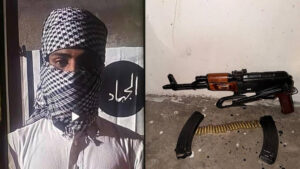
According to the investigation, Kabiruddin travelled from Assam to Bhopal and subsequently reached Vadodara, where he stayed at a hotel near Sayajigunj railway station. He allegedly switched off his regular mobile phone after reaching the city in an attempt to avoid detection. Technical surveillance subsequently tracked his movement towards Dahod, where he reportedly collected an automatic assault rifle resembling an AK-47 through a covert arrangement known as a ‘dead drop’, in which weapons are handed over without direct contact between the parties.
The ATS intercepted him on Thursday night, November 26, while he was returning towards Vadodara. Acting on intelligence inputs, a team led by DSP Harsh Upadhyay established surveillance and intercepted the suspect near Paldi bus stand, close to Hotel Darshan, on the Halol-Vadodara road.
A search of his belongings resulted in the recovery of an AK-47-type automatic assault rifle, two empty magazines, 23 live cartridges, a flag of Jaish-e-Mohammed, two mobile phones with SIM cards and approximately Rs 20,000 in cash.
The examination of his mobile phones reportedly revealed photographs and videos of the entrance gate of the Indian Air Force Station in Vadodara, Google Maps screenshots and other reconnaissance material. Some photographs allegedly had red crosses marking specific locations, which investigators believe were identified as potential target points. Videos demonstrating the operation of an AK-47-type weapon were also recovered.
Gujarat ATS Deputy Inspector General Sunil Joshi said the accused was allegedly tasked with attacking the entrance gate of the IAF installation. According to the investigators, his plan was to execute the terrorist attack and subsequently escape to Pakistan to formally join JeM. The handler allegedly wanted him to attain what the organisation describes as ‘martyrdom’.
Although the precise nature of the proposed assault is still under investigation, the alleged intention to carry out an armed terrorist attack and subsequently join the outfit in Pakistan makes the case particularly serious. The ATS has not publicly established that the planned operation was specifically a suicide bombing.
An FIR has been registered under Sections 18, 20, 23(1) and 38 of the Unlawful Activities (Prevention) Act, Sections 61, 148 and 149 of the Bharatiya Nyaya Sanhita and Section 25(1-AA) of the Arms Act.
Investigators are now widening the probe to Assam and other states to establish the source of the weapon, identify possible local facilitators and ascertain whether other individuals were involved in the alleged conspiracy.
The Tribune+2The arrest has raised questions that go beyond the immediate security threat in Gujarat. How did a young man from the Ratacherra area of Karimganj come into contact with a Pakistan-based terrorist handler? Who facilitated his alleged recruitment and radicalisation? Were there other individuals involved in preparing him for the mission, and does he represent an isolated case or a wider recruitment effort?
These are questions that the investigating agencies will have to answer. For the Northeast, particularly Assam and the neighbouring states, the case is a warning that geographical distance from the traditional theatres of terrorism does not necessarily provide immunity from the reach of extremist networks. The possibility of local youths being remotely recruited and dispatched to carry out attacks against strategic installations in distant parts of the country represents a new and seriously ominous security challenge.
For Tripura and the Northeast, the implications deserve particular attention. The Barak Valley and the adjoining region constitute an important transport corridor connecting Assam with Meghalaya, Tripura and other northeastern states. Security agencies are now expanding the probe to Assam and other states to trace the origin of the firearm, identify local facilitators, and determine whether the suspect acted alone.
Beyond the immediate threat averted in Gujarat, the arrest raises pressing questions for intelligence officials: How did a youth from Karimganj connect with a handler in Pakistan? Who aided his radicalisation locally? And is this an isolated incident or part of a broader recruitment drive?
For Assam, Tripura, and the wider Northeast, the case serves as a stark reminder that geographic distance from traditional conflict zones no longer insulates the region from transnational terror networks. Because the Barak Valley serves as a vital transit corridor linking Assam with Meghalaya, Tripura, and neighbouring states, investigators must thoroughly examine whether any logistical or sleeper links exist in the region—even though no evidence of a wider local network has surfaced so far.
Also Read :Tripura watches with concern as Hasina’s proposed return threatens sweeping violence in Bangladesh
Also Read : Gujarat ATS arrests suspected JeM operative in Panchmahal, foils plot on Vadodara Air Force station