Tripura watches with concern as Hasina’s proposed return threatens sweeping violence in Bangladesh
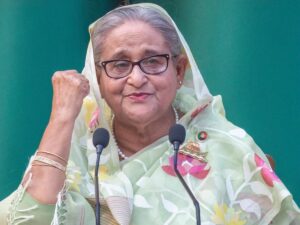
Tripura has a direct stake in the unfolding political turmoil in its neighbouring country, where former Prime Minister Sheikh Hasina’s proposed return to Dhaka on December 16 threatens to trigger another round of violent confrontation. Already witnessing escalating political clashes, crude bomb explosions, arson and attacks on properties associated with rival political camps, Bangladesh appears to be heading towards another critical juncture, raising concerns over border security and regional stability.
Hasina’s proposed homecoming, coinciding with Bangladesh’s Victory Day, could emerge as one of the most serious political flashpoints since the mass uprising of August 2024 that ended her 15-year rule. With Dhaka making it clear that she would be arrested if she entered the country, the possibility of fresh violence cannot be discounted. For Tripura, any prolonged deterioration in Bangladesh’s political and security environment could have consequences extending beyond diplomatic tensions, potentially affecting bilateral trades, tourist movements, man-to-man relations, border management, cross-border movement, and the overall security situation along the frontier.
Hasina, currently staying in India, has reportedly sought arrangements from the Bangladesh government to facilitate her return from Delhi aboard a Biman Bangladesh Airlines flight. Dhaka, however, has rejected the proposal and made it clear that she would be arrested if she entered the country. The former Prime Minister faces a death sentence pronounced in absentia in November 2025 over her government’s violent crackdown on the 2024 uprising.
The choice of December 16 is politically significant. The day commemorates Bangladesh’s victory in the 1971 Liberation War and remains one of the most emotionally charged dates in the country’s national history. By announcing her intention to return on this occasion, Hasina appears to be attempting to turn her homecoming into a larger political statement rather than a purely personal or legal matter.
Meanwhile, the situation on the ground has already become increasingly volatile. Reports of crude bomb explosions, arson and attacks on vehicles, police personnel, BNP supporters and properties associated with Nobel laureate Muhammad Yunus have emerged from several parts of the country. Police have reported incidents in at least 28 districts, prompting the authorities to strengthen security arrangements and deploy paramilitary forces.
The Grameen Bank, founded by Yunus, has also come under attack. According to reports, 97 attacks on its branches and offices were recorded between November 10 and 23. The growing frequency of such incidents indicates that the confrontation is no longer confined to political rhetoric and street demonstrations but is increasingly turning into a serious law-and-order challenge.
Hasina’s actual return, if it materialises, could further aggravate the situation. One immediate possibility is her arrest upon arrival, as indicated by the present government. Such a development could trigger demonstrations by Awami League supporters, while BNP activists and sections of the student-led movement that spearheaded the 2024 uprising could mobilise against any attempt to facilitate her political rehabilitation.
The possibility of clashes between rival political groups cannot be ruled out, particularly in Dhaka, Gopalganj and other areas where the Awami League retains an organisational presence. Retaliatory attacks on political offices, homes, businesses and individuals associated with opposing camps could follow, potentially creating localised cycles of violence and revenge.
Another possibility is that Hasina’s return could be blocked or postponed, leaving her in India. In that situation, the Awami League may continue to use the proposed homecoming as a rallying point, portraying the government in Dhaka as preventing a former Prime Minister from returning to her own country. Such a campaign could sustain political mobilisation without exposing Hasina herself to immediate arrest.
A negotiated political or legal arrangement between Dhaka and New Delhi remains a remote possibility, although the political cost of any compromise would be considerable for both sides. The present government has built much of its political legitimacy around the removal of Hasina, while the Awami League’s survival and prospects of political rehabilitation remain closely linked to its former leader.
The future of the Awami League itself has consequently become a major question. The party has a substantial historical and organisational presence in Bangladesh, and the exclusion of its political activities does not necessarily mean the disappearance of its support base. However, continued restrictions on its political participation could push sections of its supporters towards underground mobilisation, while others may gradually distance themselves from Hasina’s leadership.
The BNP, led by Tarique Rahman, also faces a difficult political challenge. It must demonstrate that it can maintain law and order, ensure accountability for the excesses of the previous regime and prevent the return of authoritarian political practices. At the same time, excessive repression against ordinary Awami League supporters could generate fresh alienation and create another cycle of political vengeance.
Although the possibility of serious political violence remains high, a nationwide breakdown of law and order or a full-scale civil conflict is not inevitable. Much will depend on the response of the police, Border Guard Bangladesh and the armed forces. A cohesive and politically neutral security establishment could contain the disturbances, but any division within the security apparatus would considerably worsen the situation.
There is also apprehension that prolonged political confrontation could acquire a communal dimension. In an increasingly polarised environment, religious minorities and politically vulnerable communities could become targets of intimidation and retaliatory attacks. The protection of these communities will therefore remain an important test of the government’s ability to maintain stability.
For India, the unfolding developments present a particularly delicate diplomatic challenge. Bangladesh has already sought Hasina’s extradition under the bilateral treaty, while New Delhi has earlier indicated that it was examining the request. Handing her over could have serious political and security implications, while allowing her to remain in India could further complicate relations with the BNP-led establishment in Dhaka. Facilitating her return without an agreed legal and security framework could also trigger fresh complications.
Adding another international dimension to the unfolding crisis, American foreign policy commentator and former Pentagon official Michael Rubin has only yesterday issued a strong warning to the Tarique Rahman-led government over Hasina’s safety. Speaking at a seminar titled ‘Bangladesh’s Future’ in New York, Rubin said the Bangladesh government would bear sole responsibility if any harm came to the former Prime Minister. “If a hair on the head of Sheikh Hasina is harmed, they, and they alone, will be held responsible,” he warned, urging the US ambassador and diplomats from other countries to convey the message clearly to Dhaka. He also called upon India to maintain a firm position and make no compromise with the Bangladeshi authorities over the issue. Rubin, who served at the Pentagon between 2002 and 2004, has been a vocal critic of developments in Bangladesh since Hasina’s ouster, repeatedly expressing concerns over the growing influence of Islamist forces, the treatment of religious minorities and the exclusion of the Awami League from the political process. His latest intervention brings an additional international dimension to the already sensitive question of Hasina’s return and could further complicate the diplomatic equation between Dhaka, New Delhi and Washington.
The developments are of particular significance for Tripura, which shares an extensive international border with Bangladesh. Any prolonged deterioration in the neighbouring country’s political and security environment could have implications for border management, cross-border movement, trade and the overall security situation along the frontier. However, there is no immediate basis to suggest that Hasina’s announcement alone would lead to a major refugee influx. But violence and political confrontations will certainly affect the trades and tourists movements severely.
Bangladesh thus appears to be approaching another critical political juncture, with three distinct forces shaping the unfolding confrontation: the Awami League and its supporters seeking political rehabilitation, the BNP establishment attempting to consolidate its authority, and the student-led and reform-oriented groups determined to prevent a restoration of the old political order.
The danger is that the country could drift towards another phase of political retribution instead of democratic reconciliation. Hasina’s return may intensify the confrontation, but even if she remains in India, the underlying political conflict is unlikely to disappear.
The immediate course of events will depend largely on how the Dhaka government handles December 16, whether the security establishment can contain the growing violence and whether New Delhi changes its position on Hasina’s extradition. These developments could determine whether Bangladesh moves towards a more stable political order or plunges into another prolonged period of uncertainty and confrontation.
(Published in the Tripura Times too)
Also Read : Awami League leaders in Agartala: BNP activists protest at Akhaura
Also Read : Sheikh Hasina’s planned return puts Bangladesh on edge – and India in a bind